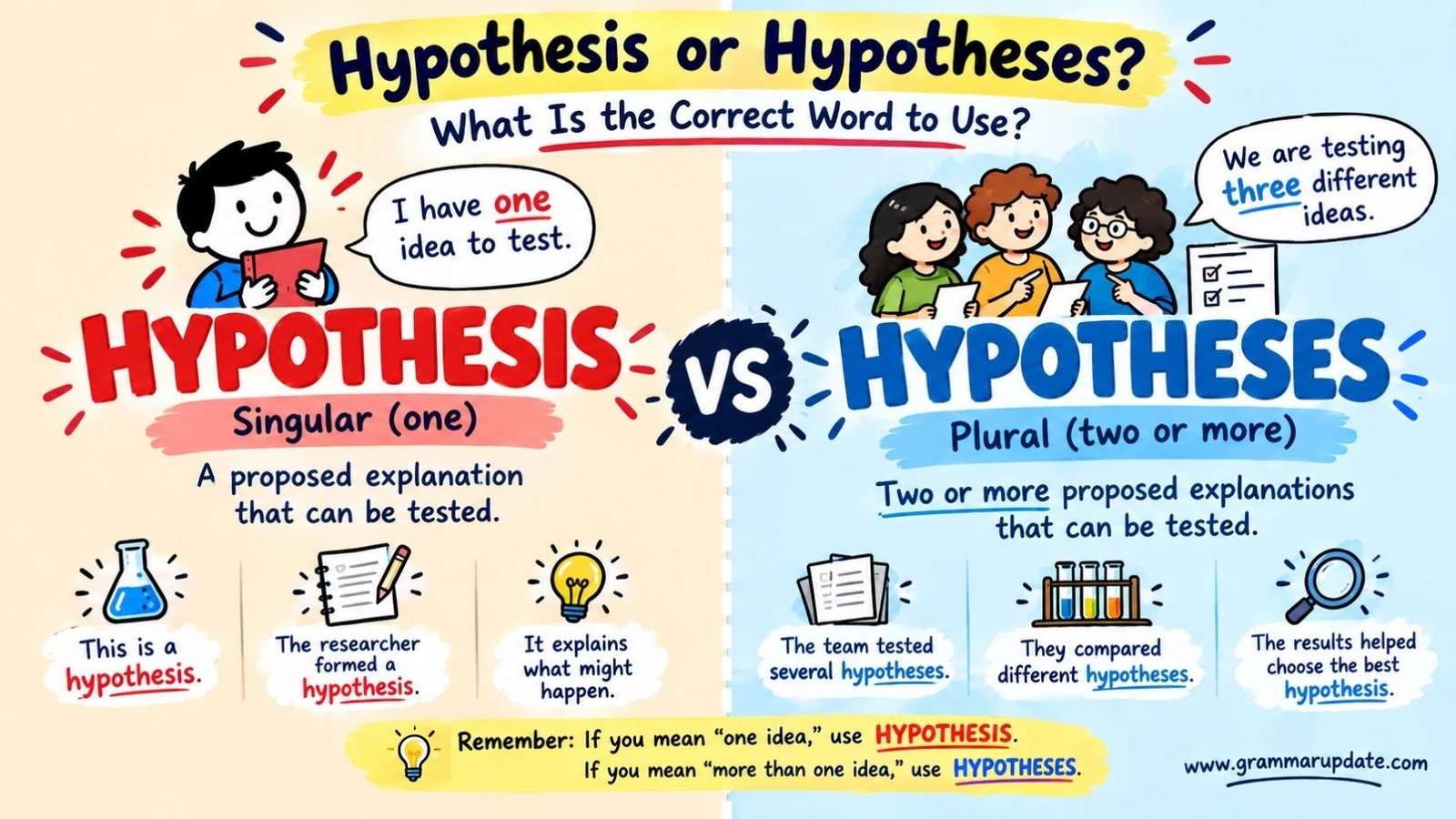
Hypothesis is the singular form, and hypotheses is the plural form of the same word. If you are talking about one idea you want to test, you use hypothesis. If you are talking about more than one, you use hypotheses. This single rule solves almost every confusion people have with the word.
The confusion usually comes from the unusual plural ending. Most English nouns simply add an “s” to become plural, but hypothesis does not follow that pattern. Understanding why this word behaves differently makes it much easier to use correctly in research papers, science classes, and everyday writing.
Hypothesis Or Hypotheses: The Simple Rule
Both words are correct. They are not two competing spellings of the same idea. They are two different grammatical forms of one word, and each one has its own job in a sentence.
- Use hypothesis when you mean one single idea, guess, or proposed explanation.
- Use hypotheses when you mean two or more of these ideas together.
| Form | Number | Example Sentence |
| Hypothesis | Singular (one) | The researcher tested her hypothesis about sleep and memory. |
| Hypotheses | Plural (two or more) | The team compared three different hypotheses before choosing one. |
A quick way to check yourself: if you can replace the word with “idea,” use hypothesis. If you can replace it with “ideas,” use hypotheses.
What Is A Hypothesis?
A hypothesis is a proposed explanation for something, based on limited evidence, that can be tested through further study or experiment. It is not a random guess. It is an educated prediction built on what is already known, and it is written so that it can be proven true or false.
In simple terms, a hypothesis answers the question: “What do I think will happen, and why?”
For example, a student who notices that plants near a window grow faster might form this hypothesis: “Plants that receive more sunlight will grow taller than plants that receive less sunlight.” This statement can then be tested with an experiment.
Key Features Of A Hypothesis
A strong hypothesis usually has a few shared qualities:
- It is testable through observation or experiment.
- It is specific rather than vague.
- It often describes a relationship between two things, called variables.
- It can be shown to be false, which scientists call “falsifiable.”
- It is based on existing knowledge, not pure speculation.
Hypothesis Meaning In Everyday Language
Outside of science labs, people also use the word hypothesis more loosely to mean an educated guess or a working theory about why something is happening.
For example, someone might say, “My hypothesis is that the meeting got cancelled because half the team is on vacation.” This is not a formal scientific hypothesis, but it borrows the same idea: a reasonable explanation offered before all the facts are confirmed.
Why Is the Plural “Hypotheses” Instead of “Hypothesises”?
This is where most of the confusion begins. The word hypothesis comes from Ancient Greek, not from standard English word-building rules. Many English words borrowed from Greek and Latin keep their original plural patterns instead of following the usual “add an s” rule.
Words ending in “-is” that come from Greek almost always change to “-es” in the plural, with the final syllable pronounced differently. Hypothesis follows this same pattern.
| Singular (–is) | Plural (–es) |
| Hypothesis | Hypotheses |
| Analysis | Analyses |
| Thesis | Theses |
| Crisis | Crises |
| Basis | Bases |
| Diagnosis | Diagnoses |
Noticing this pattern is the easiest way to remember the correct plural. If you already know that one crisis becomes two crises, you already understand why one hypothesis becomes two hypotheses.
Hypotheses Pronunciation
The pronunciation change is just as important as the spelling change, since the two words do not just look different; they sound different too.
- Hypothesis is pronounced: hy‑POTH‑uh‑sis (the stress falls on the second syllable, and the ending sounds like “sis”).
- Hypotheses is pronounced: hy‑POTH‑uh‑seez (the ending changes to sound like “seez,” rhyming with “trees”).
A simple memory trick: singular ends in a soft “sis” sound, and plural ends in a longer “seez” sound. If you can hear that difference, you will rarely misspell the word again.
Hypothesis Vs Hypotheses: Side-by-Side Comparison
| Feature | Hypothesis | Hypotheses |
| Grammatical number | Singular | Plural |
| Meaning | One proposed explanation | Two or more proposed explanations |
| Pronunciation ending | “sis” | “seez” |
| Example | “This hypothesis was rejected.” | “Both hypotheses were rejected.” |
| Common verb pairing | is, was, has | are, were, have |
Notice the verb pairing in the table above. This is one of the most common places people make mistakes, so it deserves its own section.
Common Mistakes With Hypothesis and Hypotheses
Mistake 1: Using “hypothesises” as the plural
❌ Incorrect: The scientists tested several hypothesises.
✅ Correct: The scientists tested several hypotheses.
There is no such word as “hypothesises” used this way. The correct plural always changes “is” to “es.”
Mistake 2: Pairing hypothesis with a plural verb
❌ Incorrect: The hypothesis were proven wrong.
✅ Correct: The hypothesis was proven wrong.
Since hypothesis is singular, it needs a singular verb like “is,” “was,” or “has.”
Mistake 3: Pairing hypotheses with a singular verb
❌ Incorrect: The hypotheses was tested separately.
✅ Correct: The hypotheses were tested separately.
Since hypotheses is plural, it needs a plural verb like “are,” “were,” or “have.”
Mistake 4: Confusing hypothesis with theory
A hypothesis is an early, testable explanation. A theory is a well-supported explanation that has already survived extensive testing and evidence. A hypothesis can eventually lead to a theory, but the two words are not interchangeable.
Hypothesis Or Hypotheses In Research
Academic writing is where this word appears most often, and where getting it right matters most. Research papers, theses, and lab reports depend on precise language, since a small grammar slip can make a sentence confusing to a reader or reviewer.
Writing A Single Hypothesis
When a study is built around one central prediction, the singular form is correct throughout the paper.
Example: “This study proposes the following hypothesis: increased screen time before bed reduces sleep quality in teenagers.”
Writing Multiple Hypotheses
When a study tests more than one prediction, which is common in larger research projects, the plural form is required.
Example: “This study examines two hypotheses: first, that exercise improves focus, and second, that exercise improves mood.”
How To Write A Hypothesis
A clear hypothesis usually follows a simple structure that connects a cause to an expected effect. Many researchers use an “If…then…” format, especially in early stages of study design.
- Step 1: Identify the variables. What are you changing, and what are you measuring?
- Step 2: State the expected relationship between them.
- Step 3: Make sure the statement can actually be tested.
- Step 4: Keep the wording specific and measurable, not vague.
Example: “If students study in a quiet room, then they will score higher on the test than students who study in a noisy room.”
Null Hypothesis And Alternative Hypothesis
In statistics and scientific research, hypotheses often come in pairs. Understanding this pair is essential for anyone doing hypothesis testing.
What Is A Null Hypothesis?
The null hypothesis states that there is no real effect or no real relationship between the variables being studied. It represents the default assumption, the idea that nothing unusual is happening, until evidence proves otherwise.
Example: “There is no difference in test scores between students who eat breakfast and students who do not.”
What Is An Alternative Hypothesis?
The alternative hypothesis states the opposite. It claims that there is a real effect or a real relationship, and it is the idea a researcher is often hoping to support with evidence.
Example: “Students who eat breakfast score higher on tests than students who do not.”
Null Hypothesis Example in a Table
| Type | Symbol | Statement | Meaning |
| Null Hypothesis | H0 | No effect or no difference exists | The default assumption |
| Alternative Hypothesis | H1 or Ha | An effect or difference exists | What the researcher aims to support |
Hypothesis testing is the statistical process used to decide whether there is enough evidence to reject the null hypothesis in favor of the alternative hypothesis. This process relies on data, probability, and careful analysis rather than personal opinion.
Hypothesis Examples
Seeing the word used in different situations makes the meaning much clearer.
- Science class: “My hypothesis is that ice melts faster in salt water than in fresh water.”
- Business: “Our hypothesis is that a shorter checkout process will increase online sales.”
- Psychology: “The hypothesis suggests that stress levels rise during final exam week.”
- Everyday conversation: “My hypothesis is that the traffic is bad because of the football game.”
The Sapir Whorf Hypothesis
Some hypotheses become famous enough to have their own name. The Sapir Whorf Hypothesis is a well-known idea in linguistics. It proposes that the language a person speaks can shape the way that person thinks and perceives the world.
This is a specific, named hypothesis, and the word “hypothesis” here is still singular because it refers to one overall idea, even though the idea has many parts and ongoing debate around it.
The Riemann Hypothesis
Another famous named hypothesis comes from mathematics. The Riemann Hypothesis is one of the most well-known unsolved problems in mathematics, involving the distribution of prime numbers.
Despite over a century of study, it remains unproven, which is exactly why it is still called a hypothesis rather than a theorem. Once mathematicians prove it beyond doubt, it would earn a different label.
“The Love Hypothesis”: A Popular Culture Note
The word hypothesis has also reached popular culture through the novel called “The Love Hypothesis,” a romance story that became widely popular among readers, particularly for its academic setting involving a science PhD student. Because of its popularity, many readers also search for whether the book has a movie adaptation.
As of now, any specific release date for a film version should be confirmed through current entertainment news sources, since adaptation plans can change. This cultural reference is separate from the grammatical meaning of the word, but it explains why searches for “hypothesis” often overlap with searches about the book.
Hypothesis Scrubs: A Quick Clarification
Searches sometimes combine “hypothesis” with unrelated terms like “scrubs” due to overlapping search trends or product names in unrelated categories, such as medical apparel branding.
This is not a grammar or meaning connection, and readers looking for the linguistic meaning of hypothesis should rely on the scientific and grammatical definition covered in this article rather than unrelated product searches.
Synonyms And Related Words
Several words share space with hypothesis, but each carries a slightly different shade of meaning.
| Word | Meaning | How It Differs From Hypothesis |
| Theory | A well-tested explanation supported by strong evidence | Broader and more established than a hypothesis |
| Assumption | Something accepted as true without proof | Not necessarily tested or testable |
| Prediction | A statement about what will happen | Often the result of a hypothesis, not the hypothesis itself |
| Guess | An unstructured, informal idea | Lacks the structure and testability of a hypothesis |
| Premise | A statement used as a basis for an argument | Used in logic and reasoning more than experiments |
Understanding these differences helps writers choose the most accurate word instead of using “hypothesis” as a catch-all term for any unproven idea.
Grammar Snapshot: Part of Speech
Hypothesis and hypotheses are both nouns. Neither word functions as a verb, adjective, or adverb on its own. When people want a related verb, they typically say “hypothesize,” meaning to form a hypothesis.
This verb form is spelled with a “z” in American English and often with an “s” in British English, as in “hypothesise.”
Frequently Asked Questions
Is it hypothesis or hypotheses?
Both are correct, but they are used differently. Hypothesis is singular, meaning one idea. Hypotheses is plural, meaning two or more ideas.
What is a hypothesis in simple terms?
A hypothesis is an educated guess or proposed explanation that can be tested through observation or experiment.
How do you pronounce hypotheses?
Hypotheses is pronounced hy-POTH-uh-seez, with the final syllable rhyming with “trees,” unlike the singular form, which ends in a softer “sis” sound.
Is hypotheses a real word, or is it a typo?
Hypotheses is a real, correctly spelled word. It is the standard English plural of hypothesis, following a pattern borrowed from Greek.
Can hypothesis be used as a verb?
No. Hypothesis is a noun. The related verb form is “hypothesize” in American English or “hypothesise” in British English.
Final Thoughts
Hypothesis and hypotheses are not two different spellings competing for correctness. They are the singular and plural forms of the same essential idea: a testable explanation offered before all the evidence is in. Once you remember that hypothesis refers to one idea and hypotheses refers to more than one, along with the shift in pronunciation from “sis” to “seez,” the confusion disappears almost completely.
Whether you are writing a school lab report, a formal research paper, or simply explaining your best guess about why something happened, choosing between hypothesis and hypotheses comes down to one simple question: are you talking about one idea, or several? Answer that question first, and the correct word will follow naturally every time.

Zunaira Qasim is the author and creator of Gramvixo, dedicated to making English grammar easier for learners and everyday writers. With 4 years of experience researching grammar, confusing words, word choices, and common language mistakes, they create clear and practical content that helps readers understand English and use it with confidence.