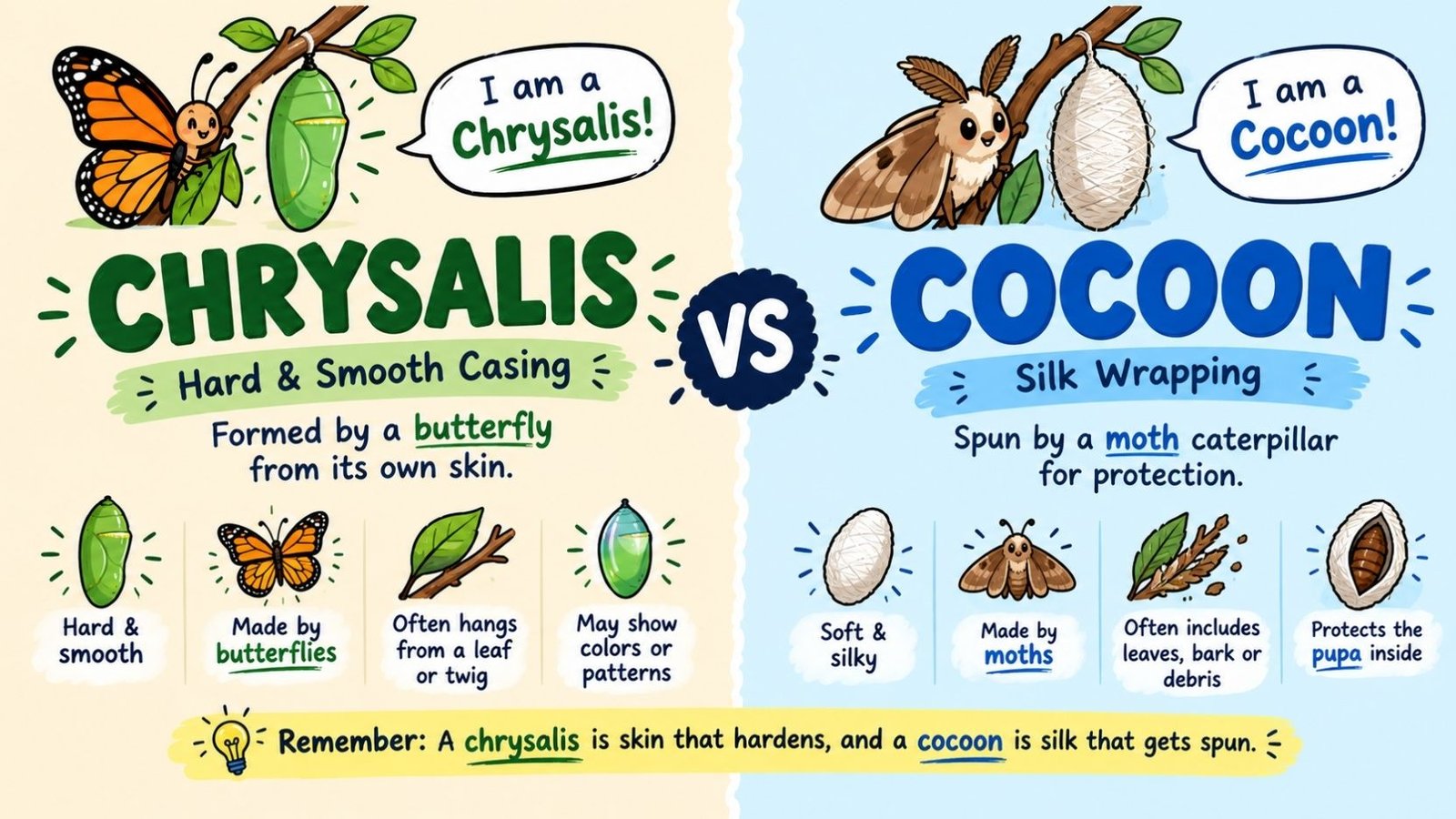
A chrysalis is the hard, smooth casing that a butterfly forms around its own body as it changes from a caterpillar into an adult. A cocoon is a soft, silk wrapping that a moth caterpillar spins around itself for the same purpose. The two words are often used as if they mean the same thing, but they describe two different structures made by two different insects.
Understanding chrysalis vs cocoon matters because the mix-up shows up everywhere, from school worksheets to nature documentaries to casual conversation. Knowing which word fits which insect helps you describe what you see in a garden, answer a child’s question correctly, or simply use English more precisely. This guide walks through the meaning, grammar, biology, and common confusions in plain language.
Quick Definition Box
| Term | Simple Meaning | Made By |
| Chrysalis | The hard casing a butterfly pupa forms from its own skin | Butterflies |
| Cocoon | A silk covering spun around the pupa for protection | Moths |
| Pupa | The general life stage between larva and adult insect | Butterflies and moths |
Read More: Surprise Or Suprise
Chrysalis Vs Cocoon Meaning
The core meaning difference comes down to material and origin.
A chrysalis is not spun. It is not woven. It forms when a caterpillar’s outer skin hardens and changes shape after its final molt. The word refers to both the object and the life stage it represents, so you might hear someone say a caterpillar “formed a chrysalis” or that it is “in its chrysalis.”
A cocoon, on the other hand, is built. A moth caterpillar produces silk from special glands and wraps that silk around its body, sometimes adding leaves, bark, or debris for camouflage. The cocoon is an outer shelter, not the pupa’s own skin. Inside that silk shelter, the actual pupa still forms separately.
So when people ask about chrysalis vs cocoon meaning, the simplest way to remember it is this: a chrysalis is skin that hardens, and a cocoon is silk that gets spun.
Chrysalis Vs Cocoon Definition
Chrysalis (noun): The hardened outer casing that a butterfly pupa forms directly from its own final larval skin, inside which the caterpillar transforms into an adult butterfly.
Cocoon (noun): A protective covering made of silk thread, spun by a moth caterpillar around itself before it pupates.
Pupa (noun): The general biological term for the resting stage between the larval and adult stages of an insect that undergoes complete metamorphosis. Both a chrysalis and a cocoon contain a pupa, but the pupa is the insect inside, while the chrysalis or cocoon is the outer casing around it.
This is a useful point that many articles skip. A chrysalis is not simply another word for pupa. The chrysalis is the shell. The pupa is what is developing inside that shell.
Chrysalis Vs Cocoon Vs Pupa
Because these three words often appear together in searches, it helps to see them side by side.
| Word | What It Describes | Belongs To |
| Pupa | The life stage itself, the resting and transforming phase | Both butterflies and moths |
| Chrysalis | The hardened shell formed from the caterpillar’s own skin during the pupal stage | Butterflies only |
| Cocoon | The silk wrapping built around the pupa for protection | Moths, and a few other insects such as some beetles and ants |
A simple way to picture it: pupa is the stage of life, chrysalis is one type of covering for that stage, and cocoon is another type of covering for that stage. A butterfly pupa is protected by a chrysalis. A moth pupa is protected by a cocoon.
Butterfly Chrysalis Vs Moth Cocoon
This comparison is the one most people are actually asking about, since butterflies and moths are the two insects most associated with these words.
Butterfly chrysalis
- Hard, smooth, and often shiny surface
- Comes directly from the caterpillar’s hardened skin
- Frequently hangs from a leaf, twig, or stem in an open, exposed position
- Can show visible colors, patterns, or even a metallic sheen depending on the species
- The monarch butterfly chrysalis is a well-known example, appearing pale green with small gold dots before the butterfly emerges
Moth cocoon
- Soft, fibrous, silk covering
- Built by the caterpillar spinning thread from silk glands
- Often hidden in leaf litter, underground, in bark crevices, or wrapped in a curled leaf
- Texture ranges from thin and papery to thick and tough depending on the species
- Some moth species mix silk with other materials, such as hair or plant matter, for extra protection
So when someone searches butterfly chrysalis vs cocoon or moth chrysalis vs cocoon, the accurate answer is that moths do not typically form a chrysalis at all. Moths spin cocoons. Butterflies form chrysalises. The word chrysalis belongs to butterflies specifically, while cocoon belongs to moths and select other insects.
Read More: Mines Vs Mine
Caterpillar Chrysalis Vs Cocoon
Before either structure appears, both butterfly and moth caterpillars go through the same basic sequence.
- The caterpillar eats and grows through several molts.
- It reaches its final larval stage and stops feeding.
- It finds a safe location to begin pupation.
- A butterfly caterpillar sheds its final skin, which then hardens into a chrysalis. A moth caterpillar spins silk threads to build a cocoon around itself.
- Inside either structure, the body reorganizes into an adult insect.
- The adult butterfly or moth eventually breaks free.
The caterpillar stage itself looks similar in both insects, crawling, eating leaves, growing larger. The real difference appears at the transformation stage, which is exactly where the words chrysalis and cocoon come into play.
Chrysalis Vs Cocoon Grammar
Both words are common nouns in English, and both follow regular grammar patterns with a small twist in spelling for one of them.
Part of speech: Chrysalis and cocoon are both countable nouns. Neither is a verb in standard usage, although cocoon is sometimes used informally as a verb, discussed below.
Chrysalis plural: The plural of chrysalis is chrysalises in everyday American English. You may also see the plural chrysalides in more formal, scientific, or older writing, which follows the original Greek pattern. Both are correct, but chrysalises is the more common and natural choice for general writing.
- Correct everyday plural: The caterpillars formed several chrysalises on the fence.
- Correct scientific plural: Researchers examined the chrysalides under a microscope.
Cocoon plural: The plural of cocoon is simply cocoons, with a regular s added, and there is no irregular alternative.
- Correct: The moths spun cocoons under the porch light.
Using cocoon as a verb: In informal English, people sometimes say someone “cocooned” themselves, meaning they wrapped up or isolated themselves comfortably, similar to how a caterpillar wraps itself in silk. This is a figurative, informal use and is common in casual writing.
- Example: She cocooned herself in blankets during the storm.
Chrysalis as a verb: Chrysalis is not used as a verb in standard English. You would say a caterpillar “forms a chrysalis,” not that it “chrysalises.”
Grammar Comparison Table
| Feature | Chrysalis | Cocoon |
| Part of speech | Noun | Noun (also informal verb) |
| Standard plural | Chrysalises | Cocoons |
| Alternate plural | Chrysalides (formal) | None |
| Verb form | Not standard | Cocooned, cocooning (informal) |
| Pronunciation | KRIS uh lis | kuh KOON |
How To Pronounce Chrysalis And Cocoon
Chrysalis is pronounced KRIS uh lis, with the stress on the first syllable. The ch at the beginning sounds like a hard k, not like the ch in chair. This trips many readers up, since the spelling looks like it should start with a soft ch sound.
Cocoon is pronounced kuh KOON, with the stress on the second syllable. Both o sounds blend into one long oo sound in the second half of the word.
💡 Tip: If you remember that chrysalis starts with a k sound, similar to words like chorus or chemistry, the pronunciation becomes much easier to recall.
Origin Of Chrysalis And Cocoon
Chrysalis comes from the Greek word khrysallis, which relates to khrysos, meaning gold. This connection makes sense once you know that many butterfly chrysalises, especially monarch chrysalises, display small gold or metallic markings. The word passed through Latin as chrysallis before entering English.
Cocoon comes from the French word cocon, which itself developed from the Occitan word coucoun, meaning eggshell. The idea of a protective shell carried over into English to describe the silk casing spun by moth larvae. The word entered English in the seventeenth century and has kept largely the same meaning since.
Both origins point back to the same basic idea: something protective wrapped around a developing creature, whether that protection comes from hardened skin with a golden tint or from woven silk resembling a shell.
Examples Of Chrysalis And Cocoon In A Sentence
Clear examples help lock in the difference between these two words.
Chrysalis examples
- The monarch caterpillar attached itself to a branch and formed a chrysalis overnight.
- Inside the chrysalis, the caterpillar’s body slowly reorganized into a butterfly.
- We watched the chrysalis for two weeks before the butterfly finally emerged.
Cocoon examples
- The silkworm spun a dense cocoon out of a single continuous thread.
- She found a papery cocoon tucked inside a curled leaf.
- The moth chewed its way out of the cocoon after several weeks.
Chrysalis Vs Cocoon In Different Contexts
Outside of biology class, both words show up in everyday language with extended or figurative meaning.
Figurative use of cocoon: People often use cocoon to describe a state of comfort, protection, or isolation, much like the physical structure a caterpillar builds.
- He spent the weekend in a cocoon of blankets and books.
- The small town felt like a cocoon, safe and disconnected from the outside world.
Figurative use of chrysalis: Chrysalis is used less often in everyday speech, but it does appear in writing to represent transformation or personal growth.
- Her college years became a kind of chrysalis, a quiet period of change before she stepped into her career.
Names and brands Both words also appear as names for businesses, products, and creative works, separate from their biological meaning. You may come across a coffee shop, spa, wellness center, or clothing line using the word chrysalis or cocoon to suggest transformation, comfort, or renewal. These uses borrow the symbolic meaning of the word rather than its literal, scientific definition. A wool coat style is sometimes marketed with a cocoon silhouette, referring to its rounded, wrapped shape rather than an actual insect structure.
None of these figurative or branded uses change the core biological definition. They simply borrow the imagery the words already carry.
Chrysalis Vs Cocoon Synonym
Neither word has a true one to one synonym, since each describes a specific biological structure. However, some related or overlapping terms appear in casual and scientific writing.
| Word | Relationship To Chrysalis Or Cocoon |
| Pupa | Broader term for the life stage inside either a chrysalis or a cocoon |
| Pupal case | Sometimes used loosely to describe a chrysalis |
| Silk casing | Descriptive phrase sometimes used instead of cocoon |
| Nymph | Not a synonym; refers to a different type of insect development without a pupal stage |
Because chrysalis and cocoon describe two physically different structures, using one as a direct synonym for the other is technically incorrect, even though it happens often in casual speech.
Common Mistakes With Chrysalis And Cocoon
Even careful writers mix these words up. Here are the most frequent errors.
❌ Incorrect: The butterfly spun a cocoon before it transformed.
✅ Correct: The butterfly formed a chrysalis before it transformed. Butterflies do not spin cocoons. They form a chrysalis from their own skin.
❌ Incorrect: The moth crawled out of its chrysalis.
✅ Correct: The moth crawled out of its cocoon. Moths emerge from cocoons, not chrysalises.
❌ Incorrect: Chrysalis and cocoon mean the same thing.
✅ Correct: Chrysalis and cocoon are related but different structures, one hardened skin, the other spun silk.
❌ Incorrect: The plural of chrysalis is chrysalis.
✅ Correct: The plural of chrysalis is chrysalises, or chrysalides in formal usage.
⚠️ A quick way to avoid the mix-up: if the insect is a butterfly, use chrysalis. If the insect is a moth, use cocoon.
Pupa Vs Chrysalis Vs Cocoon: Why The Confusion Happens
Much of the confusion comes from the fact that all three words relate to the same general phase of an insect’s life, just at different levels of detail. Pupa is the scientific umbrella term. Chrysalis and cocoon are two specific types of protective covering that occur during that pupal stage, one for butterflies and one for moths.
Nature documentaries and casual writing sometimes use chrysalis and cocoon loosely, treating them as interchangeable, which reinforces the confusion for readers. Dictionaries and entomologists, however, keep the distinction clear, since the two structures are formed in genuinely different ways.
Chrysalis Vs Cocoon Pictures: What To Look For
Although this article cannot display images, knowing what to look for helps you tell the two apart in photos or in your own garden.
- A chrysalis usually looks smooth, hard, and often hangs freely from a thin silk thread attached to a leaf or branch.
- A chrysalis may show visible color, shine, or patterning, since it is essentially hardened, pigmented skin.
- A cocoon usually looks fuzzy, papery, or fibrous, since it is made of woven silk strands.
- A cocoon is often partly hidden, tucked into leaves, bark, or soil rather than hanging in the open.
If you see a smooth, jewel-like casing hanging in plain sight, you are most likely looking at a butterfly chrysalis. If you see a soft, silk-wrapped bundle tucked into debris, you are most likely looking at a moth cocoon.
Read More: Hypothesis Or Hypotheses
Other Insects That Use Cocoons
While cocoon is most closely associated with moths, a handful of other insects also build cocoon-like structures, which adds another layer to the chrysalis vs cocoon conversation.
- Some species of ants and bees line their pupal chambers with silk-like material, sometimes loosely called a cocoon.
- Certain beetle larvae spin protective coverings before pupating.
- Silkworms, which are actually moth larvae, are the most economically significant cocoon builders, since their cocoons are harvested to produce silk fabric.
Butterflies remain the only common insect associated with a true chrysalis, since the word specifically describes their hardened skin casing rather than a spun silk structure.
Frequently Asked Questions
What is the main difference between a chrysalis and a cocoon?
A chrysalis is the hardened skin of a butterfly caterpillar, while a cocoon is a silk covering spun by a moth caterpillar. One forms naturally from skin, and the other is actively built from silk thread.
Is a chrysalis the same as a pupa?
Not exactly. The pupa is the life stage itself, the transforming insect inside. The chrysalis is the protective shell around that pupa, specific to butterflies.
Do all moths make cocoons?
Most moth species spin some form of cocoon, though the thickness and shape vary widely between species. A few moth species pupate underground without spinning a visible cocoon.
Do all butterflies form a chrysalis?
Yes, all butterfly species form a chrysalis during their pupal stage, since this is a defining feature of butterfly metamorphosis.
What is the plural of chrysalis?
The standard plural is chrysalises. Chrysalides is also correct and appears more often in formal or scientific writing.
How do you pronounce chrysalis?
It is pronounced KRIS uh lis, with a hard k sound at the start, not a soft ch sound.
Can cocoon be used as a verb?
Yes, informally. People say they cocooned themselves to describe wrapping up comfortably or isolating themselves, borrowing the image of a caterpillar in its cocoon.
Why does chrysalis relate to the word gold?
The word traces back to a Greek term connected to khrysos, meaning gold, likely because many butterfly chrysalises show small golden or metallic markings.
Is a cocoon soft or hard?
A cocoon is generally soft and fibrous, made of woven silk, unlike the hard, smooth surface of a chrysalis.
What is inside a chrysalis or cocoon?
Inside either structure is the pupa, the developing insect that is reorganizing its body from a caterpillar into an adult butterfly or moth.
Conclusion
Chrysalis and cocoon both describe protective coverings that form during an insect’s transformation from caterpillar to adult, but they are not the same thing. A chrysalis is the hardened skin of a butterfly caterpillar, smooth and often shiny, while a cocoon is a silk structure spun by a moth caterpillar, soft and fibrous in texture. Both contain a pupa, the true life stage undergoing change, but the outer casing depends entirely on which insect is forming it.
The next time you spot one of these structures in a garden, on a branch, or tucked into fallen leaves, you will know exactly what you are looking at. A hard, hanging shell points to a butterfly and its chrysalis. A soft, wrapped bundle points to a moth and its cocoon. Getting the chrysalis vs cocoon distinction right is a small detail, but it reflects a real and interesting difference in how these two insects protect themselves during one of nature’s most remarkable transformations.

Zunaira Qasim is the author and creator of Gramvixo, dedicated to making English grammar easier for learners and everyday writers. With 4 years of experience researching grammar, confusing words, word choices, and common language mistakes, they create clear and practical content that helps readers understand English and use it with confidence.