
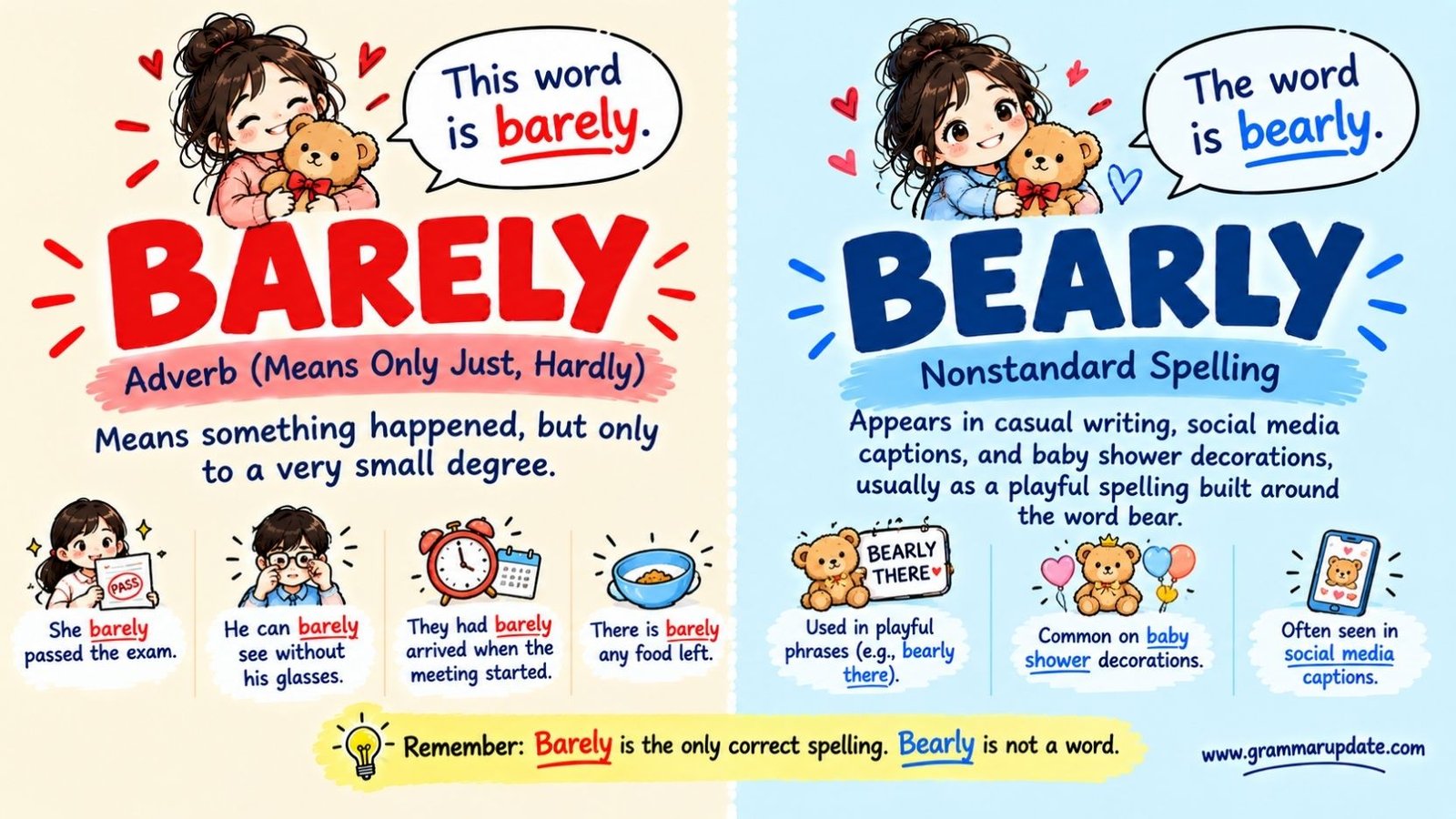
If you just typed “bearly” into a search bar, there is a good chance you already suspect something is off. You are right to wonder. The correct word in standard English is barely, not bearly. Barely is a common adverb that means only just, hardly, or by a very small amount.
Bearly is not a recognized English word. It shows up often in casual writing, social media captions, and baby shower decorations, usually as a playful spelling built around the word bear. It is not wrong because someone made a typing mistake. It is wrong because it does not exist in standard dictionaries as a real adverb.
This guide walks through the meaning of barely, why bearly keeps appearing anyway, how each word is actually used, and where the confusion tends to start. By the end, you will know exactly which word belongs in a sentence and why.
Bearly Or Barely: The Quick Answer
Barely is the correct spelling in every standard English sentence. It functions as an adverb, and it means something only happened to a very small degree, or almost did not happen at all.
Bearly, on the other hand, is a nonstandard spelling. It appears in informal contexts, novelty products, and social media trends, almost always tied to bear imagery rather than grammar. Outside of those niche, intentional uses, bearly is simply a misspelling of barely.
| Word | Status | Meaning |
| Barely | Standard English word | Only just, hardly, almost not |
| Bearly | Nonstandard spelling | Used informally, often as a pun involving bears |
See More: Mommies Or Mommy’s
What Does Barely Mean?
Barely means something happened, but only to the smallest possible degree. It signals that an action, state, or amount came close to not happening, not existing, or not being enough.
Here are the core shades of meaning:
- By a very small margin: “She barely passed the exam” means she passed, but just barely, with almost no room to spare.
- Almost not at all: “He can barely see without his glasses” means his vision is extremely limited.
- Just recently, with little gap: “They had barely arrived when the meeting started” means very little time passed between arriving and the meeting beginning.
- Scarcely, hardly: “There is barely any food left” means the amount remaining is very small.
In every case, barely narrows something down to the edge of a limit, whether that limit is time, ability, quantity, or success.
Barely: Part Of Speech And Grammar
Barely is an adverb. Adverbs typically modify verbs, adjectives, or other adverbs, and barely is no exception.
- It modifies verbs: “I barely slept last night.”
- It modifies adjectives: “The room was barely visible in the fog.”
- It modifies other adverbs: “She spoke barely audibly.”
Barely usually sits before the verb it modifies, though its position can shift slightly depending on sentence rhythm. In most everyday sentences, it appears right before the main verb, as in “I barely remember” or “We barely noticed.”
One grammar detail trips people up: barely already carries a negative meaning, so pairing it with another negative word, such as not or no, creates a double negative that sounds wrong to most fluent speakers.
- Incorrect: I don’t barely have time.
- Correct: I barely have time.
This is one of the most common grammar mistakes tied to this word, and it happens because barely feels like it needs reinforcement, when it already does the negating work on its own.
How To Pronounce Barely
Barely is pronounced BAIR-lee, with two syllables and the stress on the first one.
In IPA, it is written as /ˈbɛr.li/. The first syllable rhymes with hair, care, and fair. The second syllable is a short, unstressed “lee” sound.
There is no meaningful difference between American and British pronunciation here. Both regions pronounce it the same way, aside from small regional accent variation that affects the vowel sound slightly, the same way it would in words like there or care.
Where Does Barely Come From?
Barely comes from the Old English word bær, meaning bare or naked, combined with the adverb-forming suffix ly. Originally, barely was closer in meaning to bare or plain, describing something without addition or excess.
Over time, the meaning shifted from describing something as plain or stripped down to describing an amount or degree that is stripped down to its minimum. That shift explains why barely today means just enough, or almost not enough, rather than literally bare or exposed.
This evolution is common in English. Many adverbs that once described a physical state gradually came to describe degree or extent instead.
Why Do People Search for Bearly Instead of Barely?
Bearly is not a recognized word, but it keeps appearing for a few clear reasons.
- Phonetic confusion: Barely and bearly sound almost identical when spoken aloud, so people typing quickly, or typing from memory of how the word sounds, land on the wrong spelling.
- Autocorrect and spelling uncertainty: Some writers genuinely are not sure which spelling is correct and guess based on sound alone.
- Intentional wordplay: Many results for bearly are not mistakes at all. They are deliberate puns built around the word bear, especially in baby shower and gender reveal themes, where a bear mascot or bear-themed party matches the phrase “we can bearly wait.”
That third reason is worth separating out clearly, because it explains most of the popular searches around this topic.
We Can Bearly Wait: A Deliberate Pun, Not a Grammar Mistake
“We can bearly wait” is a popular party phrase, especially for baby showers and gender reveals that use a bear or woodland theme. It intentionally swaps barely for bearly to create a pun with bear.
This phrase appears on invitations, cakes, backdrops, signs, and decorations because it does two things at once. It uses the meaning of barely, meaning “we are so excited we can hardly wait,” while also referencing a bear theme through the spelling.
It is important to separate this from a spelling mistake. When someone writes “we can bearly wait” on a baby shower invitation with a bear cub graphic, they are using bearly on purpose, as a pun, the same way “beary excited” or “unbearlievable” work as intentional bear-themed wordplay.
Outside of this specific novelty context, writing bearly in a normal sentence, an email, an essay, or a formal document is not a pun. It is simply an error, because there is no bear-related meaning being suggested.
Bearly Art Glue: Why a Brand Name Also Uses This Spelling
Bearly Art Glue is an actual product name, made by a company that produces a precision craft glue. In this case, bearly is a brand name, not a grammar choice, and it does not need to follow standard spelling rules the way ordinary sentences do.
Brand names frequently use altered spellings for memorability or trademark purposes, and Bearly Art Glue is one clear example. If you saw this term and wondered whether it was another version of the word barely, it is not. It is a proper noun referring to a specific product.
See More: Realising Or Realizing
Barely In Different Contexts
Barely shows up across many everyday situations, and its core meaning stays consistent even as the topic changes.
Barely Working
“The old fan is barely working” means the fan technically still functions, but only just, and it may stop entirely soon. This phrase is common for describing machines, relationships, systems, or plans that are on the edge of failing.
Barely Alive
“The plant was barely alive after the frost” describes something at the very edge of survival. This phrase is used for people, animals, and plants alike, and it always signals a serious, borderline state.
Barely Awake
“She was barely awake during the meeting” describes a state of extreme tiredness, where someone is technically conscious but not fully alert. This is one of the most common everyday uses of the word.
Barely Legal
Barely legal is a phrase describing something that just meets the minimum legal standard, often referring to age-related legality. It has also been used as a media and magazine title, which is a separate, specific reference rather than a general grammar example. Because this phrase can carry different connotations depending on context, it is worth using carefully and being aware of how it may be interpreted.
Barely Used
“The car is barely used” is common in resale listings, describing an item in near-new condition because it has seen very little use. This phrase reassures a buyer that wear and tear is minimal.
Why Am I Barely Eating but Still Gaining Weight?
This is a genuine and common question, so it deserves a direct, honest answer rather than a guess.
Weight changes are influenced by many factors beyond how much food someone eats, including metabolism, hormones, sleep quality, stress levels, medication, water retention, and overall activity level. Eating very little does not automatically guarantee weight loss, because the body’s response to reduced food intake is complex and varies from person to person.
If this reflects a real, ongoing concern rather than a grammar question, a doctor or registered dietitian is best placed to look at the full picture and give guidance based on individual health history.
Barely Synonyms And Related Words
Several words overlap with barely but carry slightly different shades of meaning.
| Word | Meaning | Difference From Barely |
| Hardly | Almost not at all | Very close in meaning, often interchangeable |
| Scarcely | Only just, by a narrow margin | Slightly more formal in tone |
| Just | By a small margin | Broader word, not always about difficulty |
| Only just | Barely enough | More conversational phrasing |
Hardly and scarcely are the closest true synonyms. Both share barely’s negative undertone, meaning they should not be paired with another negative word in the same sentence for the same reason barely should not be.
Common Mistakes With Barely
Understanding a few recurring mistakes makes it much easier to use this word correctly every time.
❌ Incorrect: I don’t barely know him.
✅ Correct: I barely know him.
The word don’t adds an unnecessary second negative, since barely already limits the meaning on its own.
❌ Incorrect: She was bearly able to finish the race.
✅ Correct: She was barely able to finish the race.
Unless this is a deliberate bear-themed pun in a specific creative context, bearly is simply a misspelling here.
❌ Incorrect: We could barely not wait.
✅ Correct: We could barely wait.
Adding “not” reverses the intended meaning and creates confusing, contradictory phrasing.
Bearly Vs Barely: Side By Side Comparison
| Feature | Barely | Bearly |
| Standard English word | Yes | No |
| Found in major dictionaries | Yes | No |
| Correct in formal writing | Yes | No |
| Correct in informal, playful contexts | Yes | Only as an intentional bear pun |
| Common use case | Everyday grammar | Baby shower themes, brand names |
Quick Examples Of Barely Used Correctly
- I barely finished my homework before class started.
- The signal was barely strong enough to load the page.
- He barely spoke during the entire dinner.
- There was barely enough gas to reach the next station.
- She barely recognized her old classmate after so many years.
Each example shows the same underlying idea: something happened, or something exists, but only just, right at the edge of not happening or not existing at all.
See More: Buisness Or Business
Frequently Asked Questions
Is bearly a real word?
No, bearly is not a standard English word. Barely is the correct spelling in every normal sentence. Bearly only appears intentionally in bear-themed puns or as a brand name.
What does barely mean in a sentence?
Barely means something happened only to a very small degree, or almost did not happen at all. It signals a narrow margin, whether of time, ability, quantity, or success.
Is barely a noun or a verb?
Barely is an adverb. It modifies verbs, adjectives, or other adverbs, describing the degree or extent of an action or state.
How do you pronounce barely?
Barely is pronounced BAIR-lee, with two syllables and stress on the first syllable, similar to how hair or care is pronounced.
What is the difference between barely and hardly?
Barely and hardly are close synonyms that both mean almost not at all. Hardly can sound slightly more common in casual speech, while barely is used just as widely in both casual and formal writing.
Why do baby shower invitations say “we can bearly wait”?
This phrase intentionally swaps barely for bearly to create a pun connected to a bear theme, commonly used for bear-themed baby showers and gender reveals.
Is “I don’t barely have time” correct grammar?
No, this is a double negative and is considered incorrect in standard English. The correct form is “I barely have time,” without the added “don’t.”
What does barely legal mean?
Barely legal describes something that just meets the minimum required legal standard. It is also the title of certain media, which is a separate and specific reference rather than a general usage example.
Is Bearly Art Glue related to the word barely?
No, Bearly Art Glue is a brand name for a specific craft glue product. The spelling is a brand choice, not a grammar variation of barely.
Can bearly ever be correct in writing?
Bearly is only appropriate in deliberate, playful contexts built around bear themes, such as party decorations or product names. In every standard sentence, barely is the correct word.
Final Thoughts
Barely is the word you want in almost every situation, whether you are writing an email, a school assignment, or a casual text message. It is a well-established adverb that describes something happening only to the smallest possible degree, and it has a clear grammar role that has stayed consistent for a long time.
Bearly, by contrast, earns its place only in specific, intentional situations, mainly bear-themed party phrases and certain product names. Outside of those cases, it is simply not a word, and reaching for barely instead will always be the safer, correct choice.

Zunaira Qasim is the author and creator of Gramvixo, dedicated to making English grammar easier for learners and everyday writers. With 4 years of experience researching grammar, confusing words, word choices, and common language mistakes, they create clear and practical content that helps readers understand English and use it with confidence.
2 Comments