
Flatform and platform are two words that shoppers, designers, and everyday readers often mix up. They sound similar, and they are used in some of the same sentences about shoes and construction. But they do not mean the same thing, and swapping one for the other can confuse a reader or a customer.
This guide explains what each word means, how they are used in real sentences, and where people usually get them mixed up. You will also see how the words apply in fashion, construction, transport, and technology, since both terms show up in more than one field.
Flatform Meaning
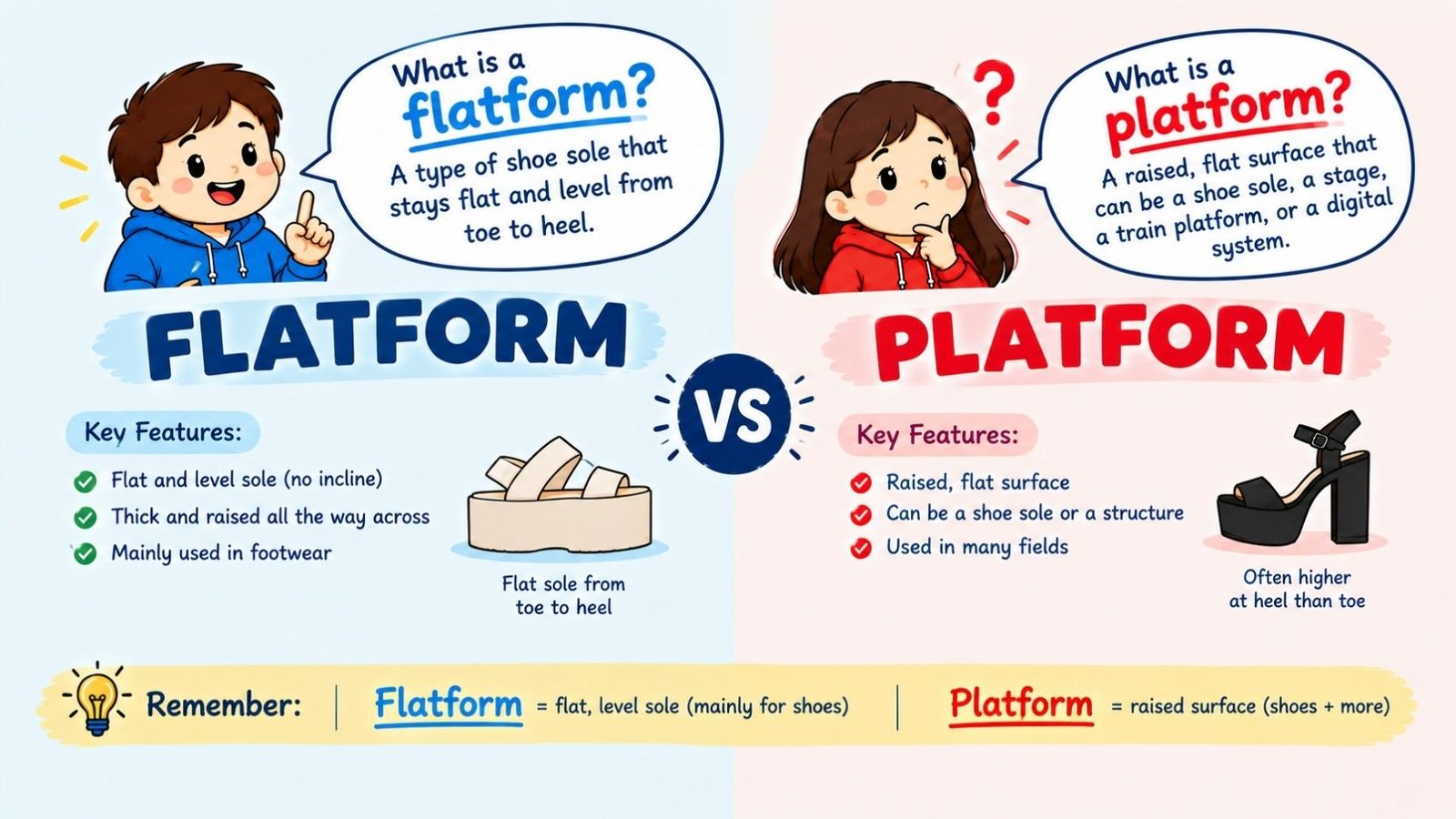
A flatform is a type of shoe sole. It looks like a high sole, similar to a wedge or a platform shoe, but the bottom of the sole stays flat instead of angling upward at the heel.
In simple terms:
- A flatform sole is thick and raised all the way across.
- The front and the back of the sole sit at the same height.
- There is no incline, so the foot stays level from toe to heel.
This is different from a wedge, where the sole rises gradually from the front to the back. It is also different from a heeled platform shoe, where the heel is noticeably higher than the front of the sole.
Part of speech: Flatform is a noun. It can also work as a modifier before another noun, such as flatform sandal or flatform boot.
Pronunciation: Flatform is pronounced FLAT form, with stress on the first syllable. It blends the words flat and platform.
See More: Bearly Or Barely
Platform Meaning
Platform is a much older and broader word. Its core meaning is a raised, flat surface that people or objects can stand on.
Platform has several common meanings depending on context:
- Meaning 1: A physical raised surface A platform is a flat, elevated structure, such as a train platform, a stage platform, or a platform used in construction.
- Meaning 2: A type of shoe sole A platform shoe has a thick sole under the entire foot, often paired with an even thicker heel. This is the meaning most closely related to flatform.
- Meaning 3: A digital or business system. In technology and business, a platform is a system or service that other products, users, or programs run on. Examples include a social media platform, a cloud platform, or a gaming platform.
- Meaning 4: A set of ideas or goals. In politics, a platform refers to the stated positions or goals of a group or a candidate.
Part of speech: Platform is a noun. Like flatform, it is often used before another noun, as in platform bed, platform shoe, or platform sneaker.
Pronunciation: Platform is pronounced PLAT form, with stress on the first syllable, similar to flatform but without the extra blended sound.
Flatform Vs Platform: The Core Difference
The clearest way to understand flatform vs platform is to compare them side by side, since most confusion happens in footwear.
| Feature | Flatform | Platform |
| Sole shape | Flat and level from toe to heel | Often higher at the heel than the toe |
| Height difference | Little to no incline | Noticeable incline in many styles |
| Common use | Sandals, espadrilles, casual shoes | Sandals, boots, heels, sneakers |
| Broader meaning | Mainly a shoe term | Also used for stages, technology, construction, and more |
| Word origin | A blend of flat and platform | An older, standalone word |
The main idea to remember: every flatform is a kind of platform sole, but not every platform is a flatform. Flatform describes a specific shape within the wider platform category.
Flatform Vs Platform In Construction
The word platform, not flatform, is the correct term in construction and engineering. A platform in this context refers to a raised, level surface built for people, equipment, or materials to stand on safely.
Flatform is not a standard construction term. If a reader searches for platform or flatform in construction, the accurate answer is that construction professionals use platform, while flatform stays limited to footwear and casual fashion language.
Flatform Vs Platform For Walking
For everyday walking, the flat sole of a flatform shoe generally feels more stable than a platform shoe with an angled heel. Since the whole sole sits level, weight is spread more evenly across the foot.
A traditional platform shoe with a raised heel can feel less steady, especially at greater heights, because the ankle has to manage the incline. This is one reason flatform sandals are often marketed as a comfortable alternative to heeled platforms.
See More: Stoping Or Stopping
Flatform vs Platform In Sandals And Shoes
Because so many product searches involve real shoe brands, it helps to see how the terms apply in practice.
- Teva flatform sandals and Teva flatform universal sandals use a flat, chunky sole with no heel incline, which is the defining feature of a flatform.
- Free People flatform sandals, such as the Harbor flatform and the Hazel flatform sandal, follow the same flat sole shape.
- Madewell Havana strappy flatform sandals and AE raffia espadrille flatform slide sandals apply the flatform sole to a strappy or espadrille style.
- FitFlop F Mode Flow flatform and Calvin Klein Jeans flatform sandal Webb are examples of brand named flatform styles.
- Gucci GG canvas flatform slide sandals show that flatform styling also appears in higher end fashion, not only casual brands.
- Platform sandals, platform boots, platform heels, and platform Uggs cover the wider group, which may or may not have a flat sole.
- Platform Sambas, platform Vans, and platform Converse refer to sneaker versions with a thickened, often flat, sole added to a classic sneaker design. In practice, many of these sneaker platforms behave like flatforms, even though brands market them as platform styles.
- Chunky flatform and flatform espadrilles describe general styles rather than one specific brand.
Quick tip: If a shoe description mentions an even sole height from toe to heel, it is describing a flatform, even if the listing uses the word platform.
Flatform Vs Platform Meaning In Everyday Language
Outside of shoes, platform is the word people use in daily conversation. Flatform almost never appears outside footwear and design discussions.
For example:
- People say platform when talking about a stage, a train platform, or a platform bed frame.
- People say platform when discussing a social media platform or a cloud platform, such as Google Cloud Platform.
- People rarely, if ever, say flatform to describe anything except a shoe sole.
If someone searches social media platform or flatform, the correct term is always platform. Flatform is not used in technology, communication, or business contexts.
Flatform Vs Platform Stage
Similarly, in event and theater settings, the correct word is platform, not flatform. A platform stage refers to a raised stage area used for performances, presentations, or ceremonies. Flatform has no established meaning in this context.
Platform In Transportation: Island Platform Vs Side Platform
Platform also appears in transportation planning, where it describes the raised area where passengers wait for a train.
- An island platform sits between two train tracks, allowing passengers to board trains going in either direction from the same platform.
- A side platform sits alongside a single track, usually paired with a matching platform on the opposite side for the other direction.
Flatform is never used in this context. Only platform applies here.
Platform In Technology
In software and business, platform describes a system that supports other applications, services, or users.
- Google Cloud Platform is a cloud computing platform used to host applications and data.
- An easiest CRM platform for a small sales team refers to customer relationship management software built to run a company’s sales process.
- Platform switching vs platform matching is a phrase used in gaming and technology, generally comparing whether a system moves between platforms or aligns features across them.
- Cross platform games, such as questions about whether Elden Ring or Stardew Valley is cross platform, refer to games that let players on different systems, like PlayStation, Xbox, and PC, play together.
In every one of these examples, platform is the only correct word. Flatform is not part of technology vocabulary.
Common Mistakes With Flatform And Platform
Incorrect: She wore flatform shoes with a high angled heel.
Correct: She wore platform shoes with a high angled heel.
Why: A flatform specifically has a flat sole. If the heel is angled higher than the toe, the shoe is a platform, not a flatform.
Incorrect: The train station has two flatforms.
Correct: The train station has two platforms.
Why: Flatform does not apply to transportation. Platform is the only correct term for a train boarding area.
Incorrect: We built our app on a flatform.
Correct: We built our app on a platform.
Why: Flatform is not used in technology or software contexts.
See More: RDN Vs RD
Similar And Related Words
| Word | Meaning | How It Differs |
| Wedge | A sole that rises gradually from toe to heel | Unlike a flatform, a wedge sole is angled, not flat |
| Heel | A raised support under the back of the foot | A heel is usually much narrower than a flatform or platform sole |
| Sneaker platform | A thickened sole added to a classic sneaker | Often flat like a flatform, but marketed under the platform name |
| Stage | A raised area for performance | Closely related to platform, but usually not used interchangeably in shoes |
Frequently Asked Questions
What does flatform mean?
Flatform means a type of shoe sole that stays flat and level from the toe to the heel, giving extra height without an angled incline.
What does platform mean?
Platform means a raised, flat surface. It can refer to a shoe sole, a train boarding area, a stage, or a digital or business system.
Is flatform a real word?
Yes. Flatform is a recognized blend word, combining flat and platform, used mainly in fashion to describe a specific type of shoe sole.
What is the difference between platform and flatform?
Platform is a broad word for any raised, flat surface or system. Flatform is a narrower term used only for a shoe sole that stays flat from toe to heel, without an angled heel.
Are flatform sandals comfortable?
Many people find flatform sandals comfortable for walking because the flat sole spreads weight evenly, unlike a platform shoe with a steep heel angle.
Is flatform used in construction?
No. Construction and engineering use the word platform, not flatform, to describe a raised working surface.
Can platform and flatform be used interchangeably in shoes?
Not accurately. A platform shoe can have a flat or an angled sole, but a flatform shoe always has a flat, level sole by definition.
Is flatform used in technology or business?
No. Flatform is not used to describe software, cloud services, or business systems. Only platform applies in those contexts.
Which word should I use for a stage or a train platform?
Use platform. Flatform has no accepted meaning in staging or transportation.
Conclusion
Flatform and platform look and sound alike, but they serve different purposes. Platform is the broader, older word, covering everything from train stations and stages to cloud computing and shoe soles. Flatform is a narrower fashion term, used only to describe a shoe sole that stays flat and level from toe to heel, without the angled heel found on many platform styles.
When you are choosing between flatform vs platform, think about what you are describing. If it involves a train, a stage, construction, or technology, platform is the correct word. If it involves a specific type of flat, level shoe sole, flatform is the more accurate and specific term.

Zunaira Qasim is the author and creator of Gramvixo, dedicated to making English grammar easier for learners and everyday writers. With 4 years of experience researching grammar, confusing words, word choices, and common language mistakes, they create clear and practical content that helps readers understand English and use it with confidence.
2 Comments