
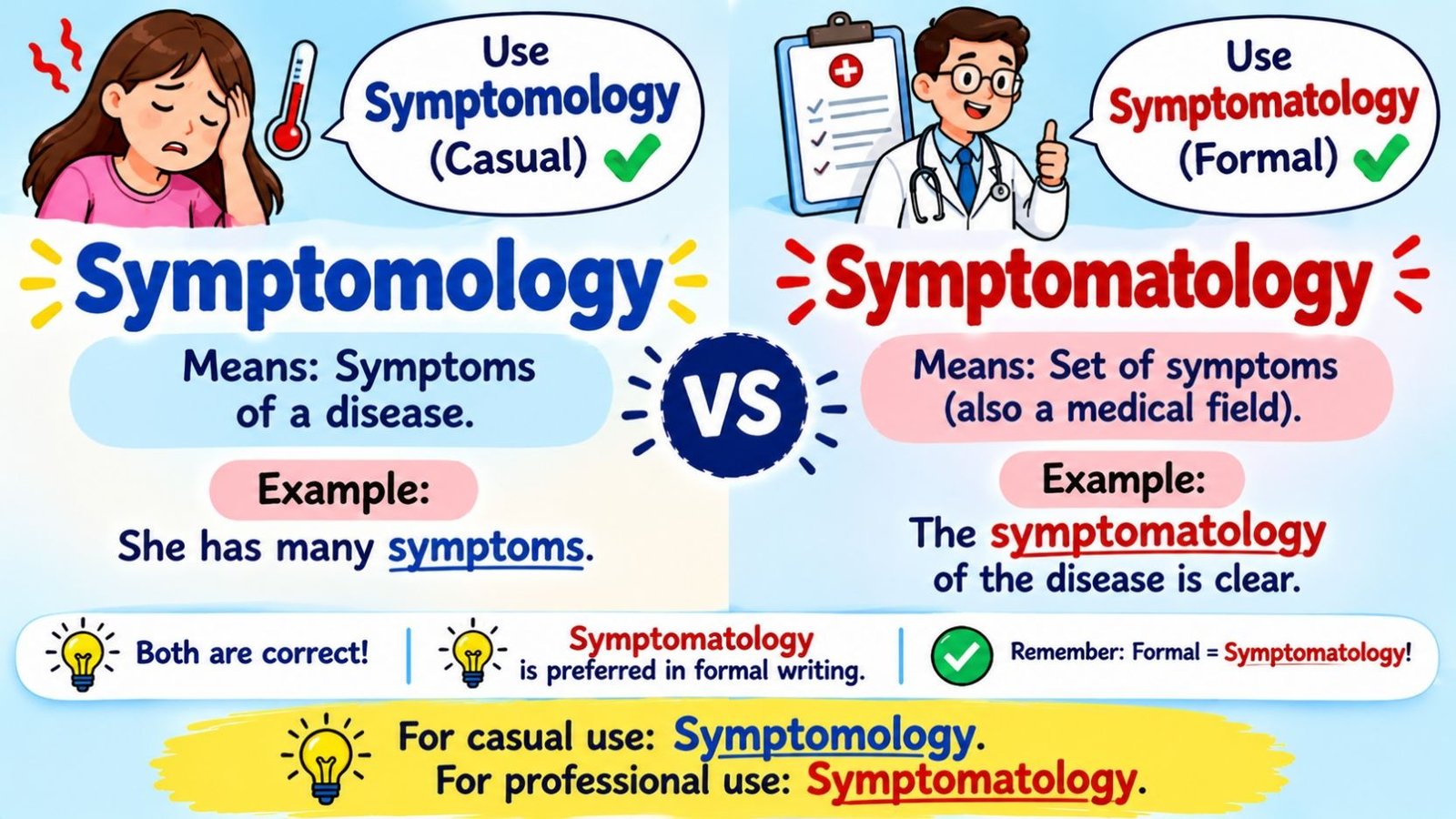
Symptomology vs symptomatology is a common source of confusion because the two words look alike, sound alike, and appear to mean the same thing. In everyday writing, most readers use them interchangeably without thinking twice. But there is a real difference in how dictionaries treat them and how professionals use them.
Symptomatology is the term accepted in medicine, psychology, and academic writing. It refers to the set of symptoms connected to a disease or condition, or to the branch of medicine that studies those symptoms. Symptomology is treated as an informal, shortened variant of the same idea, so it works in casual writing but is usually avoided in formal or clinical documents.
What Does Symptomology Mean?
Symptomology means the symptoms associated with a disease, disorder, or condition. It is used the same way symptomatology is used, except that it carries a more casual tone.
Many people search “symptomology definition” expecting a separate, distinct meaning from symptomatology. In reality, the two words point to the same concept. Dictionaries such as Wiktionary list symptomology as an informal synonym of symptomatology rather than a separate medical term with its own definition.
You will still see symptomology used in blog posts, informal health articles, casual conversations, and even some published books. It communicates the same idea clearly, so readers understand it without difficulty. The issue is not clarity. The issue is formality and professional acceptance.
Read More: Neighbour Or Neighbor: Which Spelling Is Correct?
What Does Symptomatology Mean?
Symptomatology has two closely related senses, and most dictionaries recognize both.
Sense one: the symptom complex of a disease, meaning the full set of symptoms a patient shows or reports.
Sense two: the branch of medical science that studies and classifies the symptoms of disease.
Merriam Webster defines the word as the full set of symptoms that make up a disease, and notes that it also refers to a branch of medical science concerned with symptoms. The Free Dictionary describes it in similar terms, as the branch of medical science devoted to studying disease symptoms. Collins offers a matching definition, describing it as the branch of medicine concerned with studying and classifying symptoms of disease.
So when someone writes about “the symptomatology of a disease,” they usually mean the pattern of symptoms that disease produces. When someone writes about “symptomatology” as a field, they mean the study of symptoms in general.
Symptomology Vs Symptomatology: Which Is Correct?
Both words appear in dictionaries, so neither one is technically wrong. That said, they are not treated as equals in professional writing.
Symptomatology is the standard, dictionary preferred, and professionally accepted term. It is the word you will find in medical journals, textbooks, psychiatric evaluations, and academic research. Symptomology is a shortened form that many people use casually, but style guides and healthcare writing standards generally steer writers toward symptomatology.
If you are asking which is correct, symptomology or symptomatology, the safest answer for professional, academic, or clinical writing is symptomatology. If you are writing casually, symptomology is understandable and widely recognized, though it may read as slightly less polished.
Quick Comparison Table
| Feature | Symptomology | Symptomatology |
| Formality | Informal, casual | Formal, professional |
| Common setting | Everyday writing, blogs, conversation | Medical journals, psychiatry, research papers |
| Dictionary status | Recognized, listed as informal | Recognized as the primary, standard term |
| First recorded use | 1860s | Late 1700s (1798) |
| Preferred by healthcare professionals | Rarely | Yes |
Is Symptomology A Word?
Yes, symptomology is a real, recognized word. It appears in dictionaries such as Wiktionary and the Oxford English Dictionary, and its earliest known use dates to the 1860s, with the Oxford English Dictionary tracing its earliest evidence to 1868. It is not a made-up term or a typo.
However, being a recognized word does not mean it is the preferred word in every context. Symptomology functions as an informal alternative to symptomatology, similar to how “admin” works as a casual shortening of “administration.” It is understood everywhere, but it does not carry the same weight in formal or clinical writing.
Is Symptomatology A Word?
Yes, and it has a longer, more established history than symptomology. According to the Oxford English Dictionary, the earliest known use of symptomatology as a noun dates to the late 1700s, with evidence from 1798. Etymonline traces the word to 1737, coming from medical Latin symptomatologia.
Symptomatology is the term you will find defined first, explained most thoroughly, and used most consistently across major dictionaries, including Merriam Webster, Dictionary.com, Collins, and the American Heritage Dictionary.
Grammar: Part Of Speech And Word Forms
Both symptomology and symptomatology are nouns. Neither word has a commonly used verb form, though related adjective forms do exist.
| Word | Part of speech | Related adjective |
| Symptomology | Noun | Symptomologic, symptomological |
| Symptomatology | Noun | Symptomatological |
Both nouns are typically uncountable when they refer to the general study or pattern of symptoms, as in “the patient’s symptomatology.” They can occasionally be used in plural form, such as “symptomatologies,” when comparing symptom patterns across multiple diseases or studies, though this plural use is uncommon.
Neither word takes an article automatically. You would write “the patient’s symptomatology” or “her symptomatology,” not “a symptomatology,” unless you are specifically discussing one distinct pattern among several.
How To Pronounce Symptomology And Symptomatology
Both words are long, so breaking them into syllables helps.
Symptomology: simp tuh MOL uh jee (four syllables after the root, stress falls on the third syllable, “MOL”)
Symptomatology: simp tuh muh TOL uh jee (stress falls on “TOL,” the second to last major syllable group)
The extra syllable in symptomatology, the “muh” sound before “tology,” is the main pronunciation difference between the two words. Once you notice that added syllable, the two words become easier to tell apart by ear as well as on paper.
Where Do These Words Come From?
Both words trace back to the same root: the Greek word for symptom, combined with the suffix “logy,” meaning “study of.”
According to Etymonline, symptomatology developed from medical Latin symptomatologia in 1737, built from the stem of symptoma (symptom) plus logia (study of). Wiktionary traces the same path, from Ancient Greek sumptoma (symptom) and logia (study, branch of knowledge).
Symptomology followed later. Wiktionary lists it as formed directly from “symptom” plus “ology” in English, rather than borrowed as a complete unit from Latin. This explains why symptomatology feels more historically rooted in medical Latin, while symptomology reads as a more modern, English built shortcut to the same idea.
This is also why so many people assume symptomology must be correct. English is full of words ending in “ology,” such as biology, psychology, and cardiology, so “symptomology” looks like it follows the same pattern. It does, technically, but it developed as a variant of an already existing word rather than as an original medical term.
Symptomatology And Symptomology In Different Medical Contexts
Both words appear across many areas of medicine and psychology. The meaning stays the same in each context: the pattern or set of symptoms connected to a condition.
Mental Health And Psychiatric Symptomatology
In psychiatry, symptomatology usually refers to the specific symptoms a patient reports or displays, which clinicians use to guide diagnosis and treatment.
- Psychiatric symptomatology may include mood changes, disordered thinking, or behavioral shifts.
- Psychotic symptomology can include hallucinations, delusions, or disorganized speech, though clinical writing favors “symptomatology” for this same idea.
- Depressive symptomatology often includes low mood, fatigue, and loss of interest in daily activities.
Read More: It’s Called Vs It Called: Which One Is Correct?
ADHD Symptomology And ADHD Symptomatology
Both phrasings appear in casual and clinical writing about attention and focus difficulties. Clinical sources tend to write “ADHD symptomatology” when describing research findings, while everyday health articles often use “ADHD symptomology.”
PTSD Symptomology
PTSD related writing frequently discusses symptom patterns such as flashbacks, avoidance, and heightened alertness. You will see “PTSD symptomology” in informal explainer articles, while academic and clinical sources typically write “PTSD symptomatology.”
Neurological And Radicular Symptomatology
In neurology, symptomatology describes the specific symptoms tied to nerve related conditions.
- Neurological symptomatology can include numbness, weakness, or coordination problems.
- Radicular symptomatology refers specifically to symptoms caused by pressure on a nerve root, such as pain that radiates down an arm or leg.
Coronavirus And COVID 19 Symptomology
During widespread public discussion of COVID-19, both symptomology and symptomatology appeared often. News coverage frequently used symptomatology, matching medical convention, while general audience writing leaned more often on symptomology.
Continuity Of Symptomatology
This phrase appears in clinical and insurance documentation. It refers to symptoms that persist or connect across time, showing that a current condition is linked to a previous diagnosis rather than being a new, unrelated issue.
Inventory Of Depressive Symptomatology
This phrase refers to a specific type of clinical assessment tool used to measure the severity of depression symptoms. The Quick Inventory of Depressive Symptomatology is a shortened, widely used version of this same type of assessment, commonly used in both clinical practice and research.
Structured Inventory Of Malingered Symptomatology
This is a formal psychological assessment used to evaluate whether a person may be exaggerating or fabricating symptoms. The name uses symptomatology specifically because it is a clinical instrument, and clinical instruments consistently favor the standard, dictionary-preferred term.
Symptomology In A Sentence
- Her symptomology included fatigue, joint pain, and mild fever.
- The blog post described the symptomology of seasonal allergies in simple terms.
- Doctors noted overlapping symptomology between the two conditions.
Symptomatology In A Sentence
- The patient’s symptomatology was consistent with a viral infection.
- Researchers studied the symptomatology of long COVID across different age groups.
- Her symptomatology improved steadily after starting treatment.
Common Mistakes With Symptomology And Symptomatology
Incorrect: Using symptomology in a formal research paper or clinical report without awareness that it may read as informal.
Correct: Using symptomatology in formal, academic, or clinical writing to match professional convention.
Incorrect: Assuming symptomology and symptomatology have two completely different medical definitions.
Correct: Understanding that both words describe the same core concept, with symptomatology as the more formal, accepted form.
Incorrect: Believing symptomology is a misspelling or a made-up internet word.
Correct: Recognizing that symptomology is a genuine word with its own dictionary entry and a documented history dating to the 1860s.
Read More: Disregulated Or Dysregulated: Which One Is Actually Correct?
Related Words And Similar Terms
| Word | Meaning | Difference |
| Symptom | A single sign of a disease or condition | Refers to one indicator, not the full pattern |
| Symptomatic | Showing symptoms of a condition | An adjective, not a noun describing the symptom set itself |
| Semiology (semeiology) | The study of signs and symptoms in medicine | An older, less common alternative to symptomatology |
| Diagnosis | The identification of a disease based on symptoms and testing | The outcome or conclusion, not the symptom pattern itself |
What Does It Mean When A Patient Is Symptomatic?
A patient described as symptomatic is currently showing signs or symptoms of a condition. This differs from being asymptomatic, where a person has a condition but shows no noticeable symptoms at that time.
What Is A Patient’s Baseline?
A patient’s baseline refers to their normal, typical state of health or functioning before a change, illness, or new symptom appears. Clinicians compare current symptomatology against a patient’s baseline to judge how significant a change actually is.
Frequently Asked Questions
What does symptomology mean?
Symptomology means the symptoms connected to a disease or condition. It is treated as an informal alternative to symptomatology.
What does symptomatology mean?
Symptomatology means either the full set of symptoms tied to a disease, or the branch of medical science that studies symptoms. It is the standard, dictionary preferred term.
Which is correct, symptomology or symptomatology?
Symptomatology is correct for formal, academic, and clinical writing. Symptomology is understood but reads as more casual.
Is symptomology a real word?
Yes. It appears in dictionaries and has been in documented use since the 1860s, though it functions as an informal variant of symptomatology.
Is symptomatology a real word?
Yes. It is the older, more established term, with documented use dating back to the late 1700s.
How do you pronounce symptomatology?
It is pronounced simp tuh muh TOL uh jee, with stress on the syllable “TOL.”
How do you use symptomology in a sentence?
You can write it the same way you would use symptomatology, such as: “Her symptomology matched the early signs of the flu.”
What is the difference between symptom and symptomatology?
A symptom is one single sign of illness. Symptomatology refers to the entire pattern or collection of symptoms connected to a condition.
Why do so many people confuse symptomology and symptomatology?
The words sound nearly identical when spoken quickly, they share the same root, and English commonly forms “ology” words, so symptomology looks just as valid as symptomatology even though it developed later as a shortened variant.
Final Thoughts
Symptomology and symptomatology share the same core meaning: the symptoms connected to a disease, or the study of those symptoms. Symptomatology is the older, dictionary-preferred, and professionally accepted term, with roots tracing back to medical Latin in the 1700s. Symptomology developed later as a shortened, informal version of the same idea, and while it is a genuine word, it is generally viewed as less formal.
When you are writing casually, either word will be understood. When you are writing for a medical report, academic paper, or professional audience, choose symptomatology. That single choice will make your writing sound more precise, more polished, and more aligned with how healthcare professionals and researchers actually write.

Zunaira Qasim is the author and creator of Gramvixo, dedicated to making English grammar easier for learners and everyday writers. With 4 years of experience researching grammar, confusing words, word choices, and common language mistakes, they create clear and practical content that helps readers understand English and use it with confidence.


One Comment