
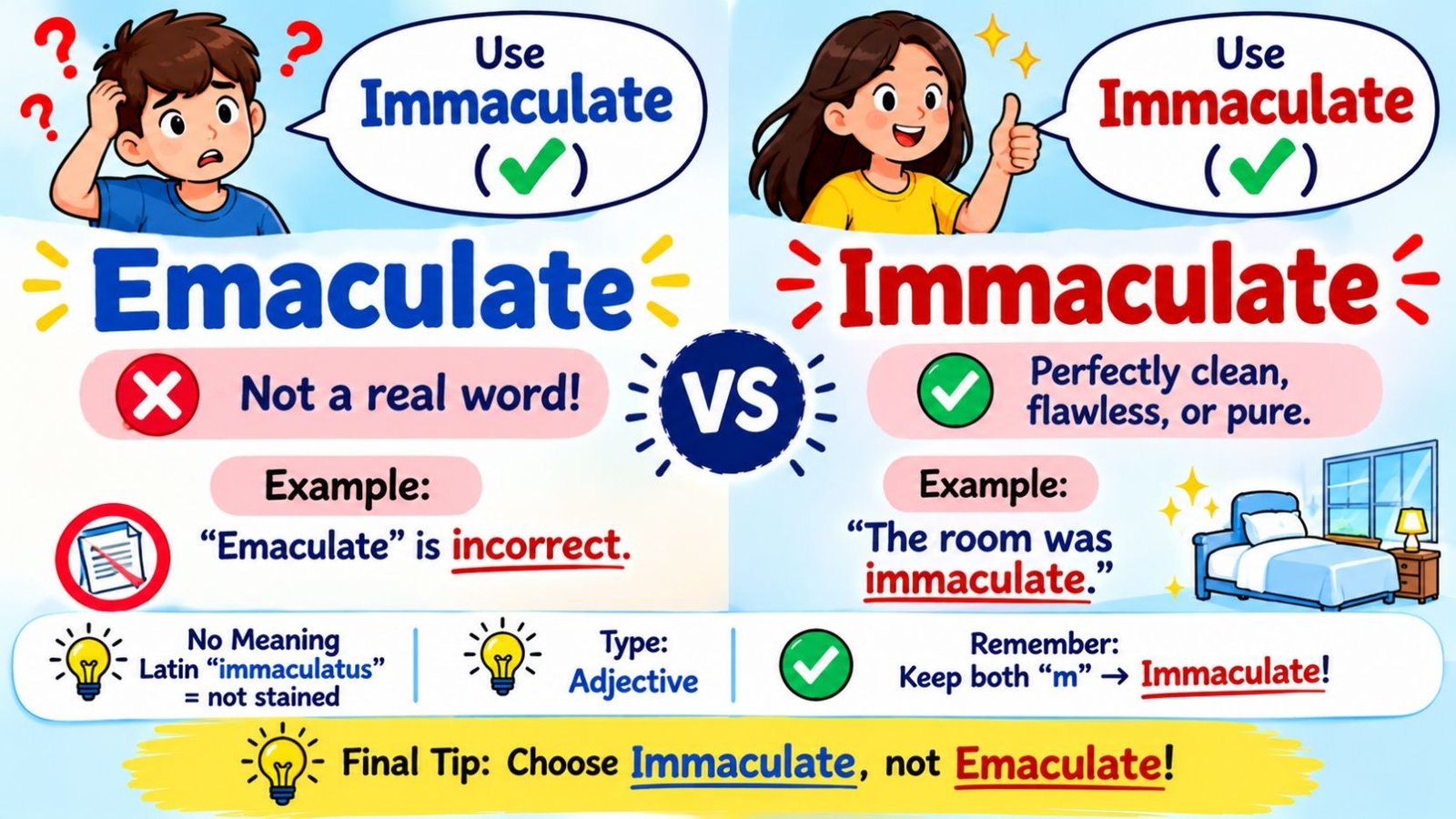
If you searched for emaculate vs immaculate, you are probably trying to figure out which spelling is correct. The short answer is simple: immaculate is the correct word. Emaculate is not a real English word, even though it looks and sounds like it could be one.
Immaculate means completely clean, free from flaws, or morally pure. People use it to describe spotless homes, flawless outfits, perfect records, and, in a religious sense, a state of purity without sin. The confusion between emaculate and immaculate usually comes from how the word sounds when spoken quickly, not from any real difference in meaning.
This article explains exactly why emaculate is a misspelling, what immaculate really means, how to use it correctly, where it came from, and how to avoid mixing it up again.
Emaculate vs Immaculate: The Quick Answer
There is no real debate here once you look at the dictionary record. Only one of these two words exists in standard English.
| Word | Is It Correct? | Meaning |
| Immaculate | Yes | Perfectly clean, spotless, or without fault |
| Emaculate | No | Not a recognized English word; a common misspelling |
Whenever someone writes “immaculate or emaculate” while trying to decide, the answer is always immaculate. Emaculate does not appear in major dictionaries such as Merriam Webster, Oxford, or Cambridge. It has no independent definition of its own.
Read More: Symptomology Vs Symptomatology: What Is The Correct Word?
What Does Emaculate Mean?
This is one of the most searched questions on this topic, so it deserves a direct answer.
Emaculate has no meaning of its own. It is not a recognized word in English. When people search for an emaculate definition or ask what does emaculate mean, they are almost always looking for the definition of immaculate.
There is a simple reason this mix-up happens so often. When immaculate is spoken naturally, the double “m” sound at the start can blend together. Many people hear something closer to “e-mac-yuh-lit” and later spell it the way it sounded, dropping one letter without realizing it. Over time, this misheard version spread widely enough that it now shows up constantly in search queries, even though it never became an accepted word.
So if you were trying to define emaculate, the honest and accurate answer is: there is nothing to define. The word you want is immaculate.
What Does Immaculate Mean?
Immaculate is an adjective. It describes something that is perfectly clean, completely free of mistakes, or without any flaw.
There are two main ways people use immaculate.
Meaning 1: Physically spotless. This is the most common everyday use. It describes something that looks perfectly clean or perfectly maintained.
Example: The hotel room was immaculate, without a single speck of dust anywhere.
Meaning 2: Free from fault or error. This use describes something flawless in quality, performance, or behavior.
Example: Her presentation was immaculate, with no errors and perfect timing.
Meaning 3: Morally or spiritually pure. This meaning is mostly used in religious contexts, especially in Catholic teaching, where it describes a state completely free from sin.
Example: The Immaculate Conception refers to Mary being conceived without original sin, according to Catholic doctrine.
These three meanings all share the same core idea: something without a single flaw, stain, or imperfection.
Immaculate: Part Of Speech And Grammar
Immaculate is an adjective. It describes a noun, and it never changes form based on number or tense.
| Grammar Point | Explanation |
| Part of speech | Adjective |
| Comparative form | More immaculate |
| Superlative form | Most immaculate |
| Adverb form | Immaculately |
| Noun form | Immaculateness (rarely used) |
Because immaculate is already an extreme adjective, meaning it describes a complete or absolute state, some careful writers avoid pairing it with words like “very.” Something is either immaculate or it is not, in the same way something is either perfect or unique. That said, “very immaculate” does appear in casual speech, and most readers will understand it without confusion, even though a stricter style guide might prefer just “immaculate” on its own.
How To Use Immaculate In A Sentence?
Immaculate usually appears directly before the noun it describes, or after a linking verb like “is,” “was,” or “looked.”
- The kitchen was immaculate after the deep clean.
- He kept an immaculate garden, with every hedge trimmed evenly.
- Her immaculate reputation made her the obvious choice for the promotion.
- The car’s interior looked immaculate, as if it had never been driven.
How To Pronounce Immaculate
Immaculate is pronounced ih MAK yuh lit, with the stress on the second syllable.
Breaking it down by syllable:
| Syllable | Sound |
| im | ihm |
| MAC | mak (stressed) |
| u | yuh |
| late | lit |
In American English, the final syllable often sounds closer to “lit” rather than a fully pronounced “late.” This soft ending is part of why the word can be misheard, and part of why “emaculate” spreads as a spelling mistake. If you say the word slowly and clearly, focusing on the double “m” at the beginning, the correct spelling becomes much easier to remember.
Where Does Immaculate Come From?
Immaculate has a Latin origin. It comes from the Latin word immaculatus, which means “unstained” or “without a spot.”
That Latin word breaks down into two parts:
- The prefix in-, meaning “not” or “without”
- The root maculatus, meaning “spotted” or “stained,” which comes from macula, meaning “spot” or “stain”
Put together, immaculatus literally means “without a stain.” English borrowed the word in this form, and the meaning has stayed remarkably close to the original Latin sense for hundreds of years.
This origin also explains why there is no version of the word starting with a single “m.” The “im” prefix is doing real grammatical work, turning “stained” into “not stained.” Removing that first letter, as emaculate does, breaks the word apart from its Latin root entirely.
Immaculate Conception: A Common Source of Confusion
Many people search for emaculate conception when they actually mean Immaculate Conception. This is a specific religious term, and it is often misunderstood even by people who spell it correctly.
The Immaculate Conception is Catholic doctrine. It teaches that Mary, the mother of Jesus, was conceived without original sin, from the very moment of her own conception. This is a common point of confusion because many people assume it refers to the conception of Jesus. It does not. It refers to Mary’s own conception.
The related but separate term Immaculate Heart of Mary refers to devotion to Mary’s heart as a symbol of her love and purity. It is a distinct concept from the Immaculate Conception, even though both use the word immaculate to describe spiritual purity.
| Term | What It Refers To |
| Immaculate Conception | Mary being conceived without original sin |
| Immaculate Heart of Mary | Catholic devotion centered on Mary’s heart and purity |
| Feast of the Immaculate Conception | A Catholic feast day, celebrated on December 8, honoring this doctrine |
Read More: Disregulated Or Dysregulated: Which One Is Actually Correct?
Immaculate Reception: A Famous Piece Of Sports History
Immaculate reception is a different kind of search entirely, and it has nothing to do with grammar or religion. It refers to a famous play in American football history, made by the Pittsburgh Steelers during a 1972 playoff game.
The name became attached to the play because of how improbable and dramatic the catch was, borrowing the sense of something remarkable and almost impossible, similar to how “immaculate” suggests something flawless.
This shows how a word can travel far from its original meaning while still carrying its core sense of something extraordinary or without flaw.
Immaculate Grid: A Popular Sports Game
Immaculate grid is a daily trivia game, popular among sports fans, where players fill in a grid by naming athletes who match two overlapping categories, such as a team and a statistical achievement. Versions of this game exist for the NFL, NBA, MLB, and other leagues, which is why searches for immaculate grid nfl, immaculate grid nba, and immaculate grid baseball are so common.
The word “immaculate” here is used the same way it is used everywhere else: to suggest a perfect or flawless result, in this case a perfectly completed grid with no mistakes.
Immaculate The Movie
Immaculate is also the title of a 2024 horror film, which contributes to some of the search traffic around this word. Searches like “the immaculate room” or “cast of immaculate” are usually about entertainment, not grammar, but they show how widely the word has been adopted across different contexts, from religion to sports to film titles.
Other Contexts Where Immaculate Appears
Beyond its core meanings, immaculate shows up in a few specific phrases worth knowing.
Immaculate inning, used in baseball, describes an inning in which a pitcher strikes out all three batters using only nine pitches, the minimum possible. It is considered a rare and impressive achievement, which is why it borrows the word immaculate.
Immaculate degeneration is a medical term, sometimes used to describe a condition affecting the retina without an identifiable underlying cause. This is a specialized, technical use, and it is unrelated to the everyday meaning of the word.
Immaculate bar, in casual or slang use, generally describes a bar, restaurant, or venue that looks extremely clean, stylish, or well put together, often used as a compliment about atmosphere or presentation.
Immaculate In Urdu
For readers searching for the meaning of immaculate in Urdu, the word is generally translated as بے عیب, meaning “without fault” or “flawless,” or سُتھرا, meaning “clean” or “spotless,” depending on context. As with English, the exact translation can shift slightly depending on whether the sentence is describing physical cleanliness or moral purity.
Synonyms And Related Words
Several words overlap with immaculate, though each carries a slightly different shade of meaning.
| Word | Meaning | How It Differs From Immaculate |
| Spotless | Completely clean, with no dirt or marks | Focuses only on physical cleanliness, not moral purity |
| Flawless | Without any defect or mistake | Often used for performance, skill, or appearance |
| Impeccable | Perfect and beyond criticism | Frequently used for manners, taste, or timing |
| Pristine | In original, untouched condition | Suggests something new or unspoiled, not just clean |
| Perfect | Without any flaw at all | Broader in meaning, used in almost any context |
Immaculate and impeccable are often used interchangeably, but there is a subtle difference. Impeccable tends to describe behavior, judgment, or style, as in “impeccable manners,” while immaculate leans more toward physical cleanliness or moral purity, as in “an immaculate kitchen” or “an immaculate reputation.” Both words can describe a flawless outcome, but the contexts where each one feels most natural are slightly different.
Antonyms Of Immaculate
Understanding the opposite of a word can also make its meaning clearer.
- Dirty
- Stained
- Messy
- Flawed
- Imperfect
- Tarnished
Each of these words describes the presence of some fault, mark, or imperfection, which is exactly what immaculate rules out.
Common Mistakes With Immaculate
Because the confusion between emaculate and immaculate is so widespread, it helps to see the mistake corrected directly.
❌ Incorrect: The house looked emaculate after the renovation.
✅ Correct: The house looked immaculate after the renovation.
❌ Incorrect: She has an emaculate sense of style.
✅ Correct: She has an immaculate sense of style.
❌ Incorrect: What is the emaculate definition?
✅ Correct: What is the immaculate definition?
💡 Tip: If you remember that the word comes from the Latin immaculatus, meaning “not stained,” it becomes easier to recall that the correct spelling keeps both letters in “im.”
⚠️ Common mistake: Writing “emaculate” because of how the word sounds when spoken quickly. Slowing down the pronunciation, especially the first syllable, usually fixes this.
Read More: Neighbour Or Neighbor: Which Spelling Is Correct?
How To Remember The Correct Spelling?
A simple memory trick can help lock in the correct spelling for good. Think of the word as two parts: “im,” meaning “not,” plus “maculate,” an older word related to “stained” or “spotted.”
Put together, immaculate literally means “not stained.” Since the word begins with the negative prefix “im,” it always needs that full “im” at the start. There is no version of the word that drops the first letter and still makes sense.
Frequently Asked Questions
Is emaculate a real word?
No. Emaculate is not a recognized English word. It is a common misspelling of immaculate.
What does immaculate mean in simple terms?
Immaculate means perfectly clean or completely free from flaws or mistakes.
Is immaculate a noun, verb, or adjective?
Immaculate is an adjective. It describes a noun, such as an immaculate room or an immaculate record.
How do you pronounce immaculate?
It is pronounced ih MAK yuh lit, with the main stress on the second syllable.
What is the difference between immaculate and impeccable?
Immaculate usually describes physical cleanliness or purity, while impeccable more often describes behavior, taste, or judgment. Both words describe something flawless.
What is the Immaculate Conception?
It is Catholic doctrine teaching that Mary was conceived without original sin. It refers to Mary’s own conception, not the conception of Jesus.
Where does the word immaculate come from?
It comes from the Latin word immaculatus, meaning “unstained,” built from the prefix “in,” meaning “not,” and “maculatus,” meaning “spotted” or “stained.”
Why do people spell it emaculate instead of immaculate?
The mistake usually comes from how the word sounds when spoken casually. The double “m” at the beginning can blend, leading people to drop a letter when writing it.
What is an immaculate grid?
It is a popular sports trivia game where players name athletes who fit two overlapping categories on a grid, with versions for the NFL, NBA, and MLB.
What is an immaculate inning in baseball?
It is when a pitcher strikes out three batters in a row using only nine pitches, the fewest possible, in a single inning.
Final Thoughts
Emaculate and immaculate are not two competing spellings of the same word. Only immaculate exists in standard English, and it carries a clear, useful meaning: something perfectly clean, flawless, or completely free from fault. The confusion mostly comes down to pronunciation, not any real ambiguity in the language itself.
The next time you are unsure which spelling to use, remember the Latin root: immaculatus, meaning “not stained.” Keep both letters in “im,” and the correct word, and the correct meaning, will follow naturally every time.

Zunaira Qasim is the author and creator of Gramvixo, dedicated to making English grammar easier for learners and everyday writers. With 4 years of experience researching grammar, confusing words, word choices, and common language mistakes, they create clear and practical content that helps readers understand English and use it with confidence.

One Comment