If you are writing a sentence and pause to ask whether it should be bellow or below, you are not alone. These two words look almost identical, sound similar when spoken quickly, and get mixed up constantly in emails, essays, and everyday writing. The short answer is that below is almost always the word you want when you mean “under” or “lower than.” Bellow is a completely different word that means to shout loudly or make a deep, roaring sound.
Understanding why these two words get confused matters more than just memorizing which one is correct. Once you see how they differ in meaning, spelling, and grammar, you will never second guess yourself again. This guide breaks down the definitions, the grammar behind each word, real examples, common mistakes, and answers to the questions people search for most.
Bellow Or Below: The Simple Answer
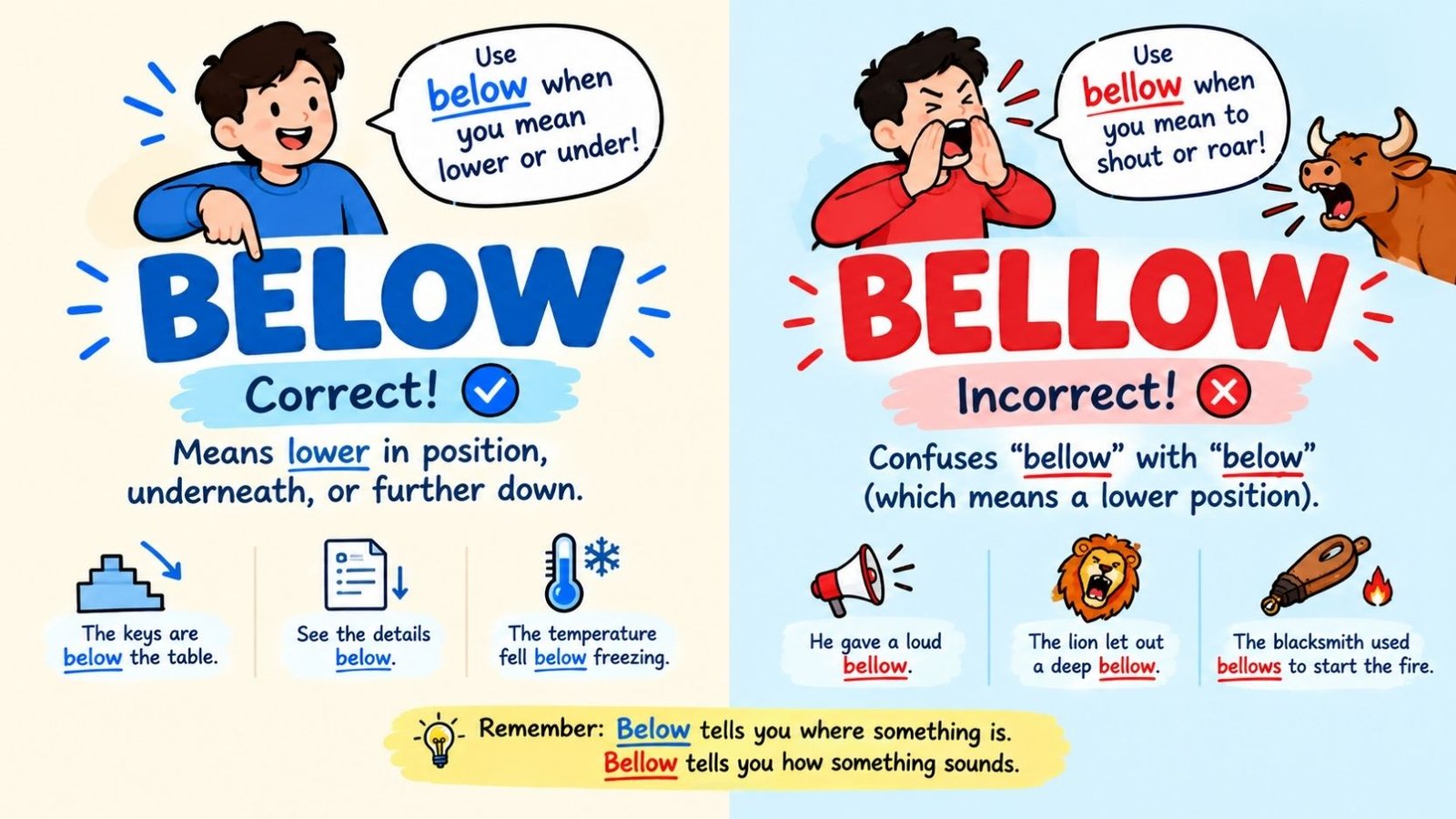
Below is the correct word when you are talking about position, location, or something that comes after in a document. It functions as a preposition or an adverb, and it means underneath, lower in position, or further down. If you are writing “see below” or “the temperature dropped below freezing,” below is the word you need.
Bellow is correct when you are describing a loud, deep shout or roar. It can also refer to the tool used to blow air into a fire, more commonly spelled as bellows. These two words share a similar sound but nothing else in common, which is exactly why people mistype one for the other.
See More: Patient Or Pacient
Bellow Or Below: Quick Comparison Table
| Word | Part of Speech | Meaning | Example |
| Below | Preposition, Adverb | Lower in position, underneath, further down | The keys are below the table. |
| Bellow | Verb, Noun | To shout loudly, a deep roaring sound | He gave a loud bellow across the field. |
What Does Below Mean?
Below describes something positioned lower than something else. It can point to a physical location, a number on a scale, or a section further down in a written document.
- Meaning 1: Physical position. Below means underneath or lower than something else in space. For example, the basement is below the kitchen.
- Meaning 2: Numbers and measurements. Below is used to describe something under a certain amount or level. A score below 50 is considered a fail in many grading systems.
- Meaning 3: Written or spoken reference. Below often points readers toward information that comes later in a document, email, or page. “Please see the details below” is one of the most common phrases in professional writing.
What Does Bellow Mean?
Bellow refers to a loud, deep shout or cry, often associated with anger, pain, excitement, or an attempt to be heard over noise or distance.
- Meaning 1: A loud shout. As a verb, to bellow means to shout in a loud, deep voice. “The coach bellowed instructions from the sideline.”
- Meaning 2: An animal sound. Bellow is frequently used to describe the deep sound made by large animals such as bulls or elephants.
- Meaning 3: The noun form. As a noun, a bellow refers to the loud sound itself. “His bellow could be heard from the other side of the stadium.”
Related word: Bellows. Bellows, almost always used in plural form, refers to a device that pumps air, historically used to fan flames in a fireplace or forge. This is a separate but related meaning that shares the same root idea of forcing air out with force.
Bellow Or Below: Grammar Breakdown
Understanding the grammar behind each word helps explain why they cannot be swapped, even though they look alike.
Below As A Preposition
When below functions as a preposition, it connects a noun to the rest of the sentence to show position.
Structure: below + noun
Example: The cat is hiding below the porch.
Below As An Adverb
Below can also function as an adverb, describing where something is without needing a following noun.
Example: You will find the answer below.
Bellow As A Verb
Bellow works as an action verb, describing the act of shouting.
Structure: subject + bellow(ed) + object or phrase
Example: The manager bellowed at the team to hurry up.
Bellow As A Noun
Bellow can also be a noun representing the sound itself.
Example: A deep bellow echoed through the barn.
See More: Jewelry Or Jewellery
Pronunciation
Below and bellow are pronounced differently, even though they look similar in writing.
- Below is pronounced with the stress on the second syllable: buh LOH. The vowel sound at the end rhymes with “go” or “slow.”
- Bellow is pronounced with the stress on the first syllable: BEL oh. The first syllable rhymes with “bell.”
Saying both words out loud a few times can help train your ear to catch the difference, which often prevents the spelling mistake in writing as well.
Origin Of Below And Bellow
Below comes from Middle English, formed by combining “be” (meaning “by” or “near”) with “low.” The word has carried the meaning of a lower position for centuries, and its structure has remained fairly stable in modern English.
Bellow comes from an Old English root related to bellan, meaning to roar or bark. This root also connects historically to the word “bull,” reflecting the deep, forceful sound bulls are known for making. Over time, bellow developed into the verb and noun used today to describe a loud shout or roar.
Bellow Or Below In A Sentence
Seeing both words used correctly in context makes the difference easier to remember.
Below in a sentence:
- The instructions are listed below.
- Temperatures dropped below zero overnight.
- She lives in the apartment below ours.
Bellow in a sentence:
- He had to bellow to be heard over the crowd.
- The bull let out a deep bellow before charging.
- Her bellow of laughter filled the entire room.
Common Mistakes With Bellow Or Below
⚠️ Common mistake: Writing “please see bellow” instead of “please see below.”
❌ Incorrect: Please see bellow for the attached file.
✅ Correct: Please see below for the attached file.
⚠️ Common mistake: Using below when describing a loud sound.
❌ Incorrect: He let out a loud below when he saw the score.
✅ Correct: He let out a loud bellow when he saw the score.
⚠️ Common mistake: Confusing bellow with the tool “bellows.”
❌ Incorrect: He used a bellow to fan the fire.
✅ Correct: He used a pair of bellows to fan the fire.
💡 Tip: If your sentence is about location, position, or “further down the page,” you want below. If your sentence is about a loud shout or roar, you want bellow.
Bellow or Below: Synonyms and Related Words
| Word | Meaning | How It Differs |
| Under | Positioned lower than something | Similar to below but often used with physical contact or coverage, like “under the bed” |
| Beneath | Lower than, often more formal | Common in written or literary contexts rather than casual speech |
| Roar | A loud, deep sound | Often used for animals or intense sounds, similar to bellow |
| Shout | To speak loudly | Broader term than bellow, which implies a deeper, more forceful sound |
| Yell | To cry out loudly | More casual and general than bellow |
Below Versus Above
Below and above are direct opposites. Above means higher in position, while below means lower in position. This pair is often used together in writing, such as “the information above explains the process, while the details below cover the exceptions.”
As Above, So Below: What Does It Mean?
This phrase originates from ancient philosophical and spiritual traditions, suggesting that patterns seen in the larger universe are reflected in smaller, individual experiences.
In modern usage, people often use it more loosely to suggest that outer conditions and inner conditions mirror each other. This phrase has no connection to the word bellow.
Is Bellow A Real Word?
Yes, bellow is a legitimate English word with a long history. It is not a misspelling of below. Bellow has its own distinct meaning centered on loud sound, and it appears in every major dictionary as both a verb and a noun.
See More: Stoping Or Stopping
Frequently Asked Questions
What does bellow mean?
Bellow means to shout loudly in a deep voice, or the loud sound itself, often associated with anger, pain, or an animal’s roar.
Is bellow a noun or a verb?
Bellow can be both. As a verb, it means to shout loudly. As a noun, it refers to the loud sound produced.
How do you pronounce below?
Below is pronounced buh LOH, with the stress on the second syllable, rhyming with “go.”
How do you pronounce bellow?
Bellow is pronounced BEL oh, with the stress on the first syllable, rhyming with “bell.”
What is the difference between bellow and bellows?
Bellow, without the “s,” refers to a loud shout. Bellows, almost always plural, refers to the tool used to pump air, historically used with fireplaces and forges.
Can below be used as an adjective?
Below is occasionally used informally before a noun, such as “the below chart,” though many style guides prefer rewriting this as “the chart below” for smoother, more formal writing.
Is “down below” correct grammar?
Yes, “down below” is a common and acceptable phrase in casual speech and writing, used for emphasis when pointing to something in a lower position.
Why do people confuse bellow and below?
The two words share several letters and a similar sound pattern, which makes it easy to type one when meaning the other, especially when writing quickly.
Does bellow ever mean the same thing as below?
No. The two words share no meaning in common. Below relates to position, while bellow relates to sound.
Final Takeaway
Below and bellow may look like close cousins on the page, but they belong to completely different families of meaning. Below tells you where something is, whether that is physically underneath, numerically lower, or further down in a document. Bellow tells you how something sounds, describing a loud, deep shout or roar that carries force and emotion behind it.
The next time you type a sentence and pause on which word to use, ask yourself a simple question: am I describing a position, or am I describing a sound? If the answer is position, reach for below. If the answer is sound, reach for bellow. With that one distinction in mind, you will spell it correctly every time.

Zunaira Qasim is the author and creator of Gramvixo, dedicated to making English grammar easier for learners and everyday writers. With 4 years of experience researching grammar, confusing words, word choices, and common language mistakes, they create clear and practical content that helps readers understand English and use it with confidence.