
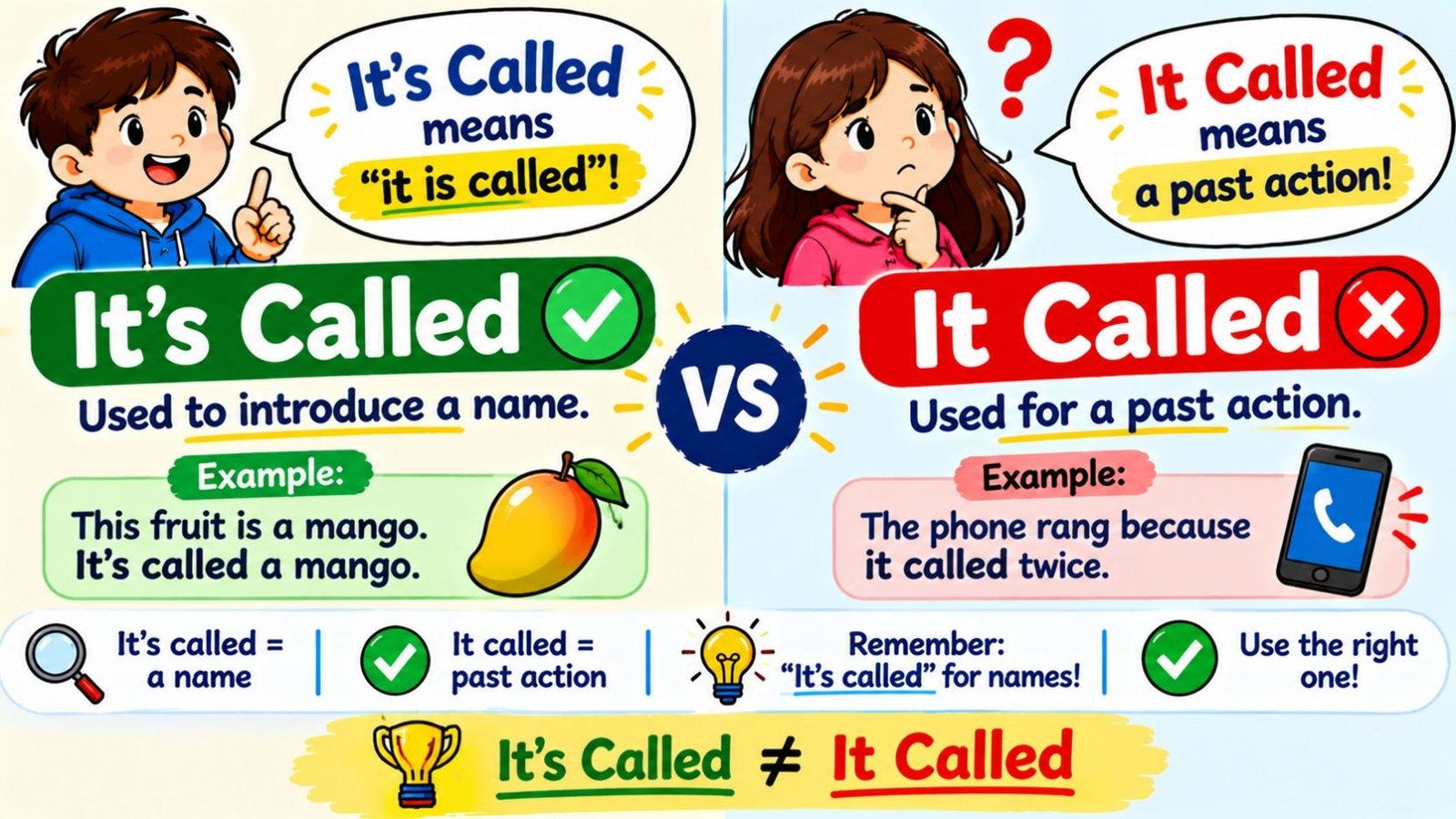
The correct phrase for naming something is “it’s called,” not “it called.” “It’s called” means “it is called,” describing what something is named. “It called” is a completely different grammar structure with a different meaning. Understanding this difference will help you avoid a common English mistake.
Many people confuse these two phrases because they look similar in writing. But “it’s called” and “it called” serve completely different grammatical purposes. One introduces a name or label, while the other describes a past action. This guide breaks down the meaning, grammar, and correct usage of both.
What Does “It’s Called” Mean?
“It’s called” is a contraction of “it is called.”
This phrase is used to introduce the name of something. You use it when you want to tell someone what a thing, place, event, or idea is officially or commonly known as.
Example sentences:
- This dish is delicious. It’s called paella.
- Have you heard of this holiday? It’s called Juneteenth.
- The tool on your desk? It’s called a stapler.
In each case, “it’s called” connects a subject to its name. The structure works like this: subject, plus “it’s called,” plus the name.
Read More: Tomorrow Vs Tommorrow: Which Spelling Is Correct?
What Does “It Called” Mean?
“It called” is the simple past tense of the verb “to call.”
This phrase does not introduce a name. Instead, it describes an action that already happened. The subject “it” performed the act of calling, whether that means making a phone call, making a sound, or summoning something.
Example sentences:
- The phone rang because it called your number by mistake.
- The bird sang loudly. It called to its mate.
- Nature called, so it called us back to the mountains.
Notice that none of these sentences introduce a name. They all describe something that happened in the past.
It’s Called vs It Called: Quick Comparison
| Phrase | Grammar Type | Purpose | Example |
| It’s called | Contraction of “it is called” | Introduces a name or label | This fruit is a mango. It’s called a stone fruit. |
| It called | Simple past tense of “call” | Describes a completed action | The dog barked, then it called for attention. |
These two phrases are not interchangeable. They answer completely different questions. “It’s called” answers “what is this named?” while “it called” answers “what did this do?”
Why “It’s Called” Is the Correct Choice for Naming
When someone asks “what is it called,” they want to know a name. The correct response always uses “it’s called,” never “it called.”
Think about the underlying sentence structure:
Correct: It is called a wife beater. → It’s called a wife beater.
Incorrect: It called a wife beater.
The second sentence doesn’t make sense grammatically. “Called” needs a helping verb like “is,” “was,” or “has been” when describing a name. Without that helping verb, “called” becomes a standalone past tense action, which changes the entire meaning.
💡 Tip: If you can replace “it’s called” with “it is called” and the sentence still makes sense, you’re using the correct form.
Read More: Prouder Or More Proud: Which One Is Actually Correct?
Common Mistakes With “It’s Called” and “It Called”
Mistake 1: Dropping the apostrophe
❌ Incorrect: Its called a flea market.
✅ Correct: It’s called a flea market.
“Its” without an apostrophe is a possessive pronoun, similar to “his” or “her.” It does not mean “it is.” Dropping the apostrophe changes the sentence into something that doesn’t grammatically work.
Mistake 2: Using “it called” when you mean a name
❌ Incorrect: Why it called Death Valley?
✅ Correct: Why is it called Death Valley?
This mistake often happens because English learners translate directly from their native language, where a helping verb like “is” might not be required in the same way.
Mistake 3: Confusing tense
❌ Incorrect: Yesterday, it’s called the wrong number.
✅ Correct: Yesterday, it called the wrong number.
Here, the writer wants the past tense action of calling, not a naming statement. Since the event happened in the past and describes an action, “it called” is actually correct in this specific case.
“It’s Called” in Everyday Questions
Many common questions rely on the “it’s called” or “is it called” structure. Here are a few familiar examples and what they’re really asking:
Why is it called Good Friday?
This question asks about the origin of a name, so the “is it called” structure fits naturally.
Why is it called pickleball?
Again, this is a request for the reasoning behind a name, not a report of a past action.
What is it called when you can’t sleep?
This question is looking for the correct term or label for a condition.
What is it called when you have two different colored eyes?
This is another naming question, seeking a specific term (heterochromia).
Why is it called Bluetooth?
This asks about the story or reasoning behind the technology’s name.
In every one of these examples, the question is about identifying or explaining a name. That’s why the structure always includes a form of “to be,” such as “is,” rather than the simple past tense “called” on its own.
Formal and Informal Usage
In formal writing, always use the full form “it is called” rather than the contraction “it’s called.” Academic papers, official documents, and professional reports generally avoid contractions.
Formal: It is called the Silent Generation because of the era’s cultural climate. Informal: It’s called the Silent Generation because of the era’s cultural climate.
Both sentences are grammatically correct. The difference is tone. Contractions like “it’s” feel conversational and are common in blog posts, casual writing, and everyday speech. The full form “it is” feels more formal and polished.
“It’s Called” vs “So Called”
These two phrases are sometimes confused, but they serve different purposes.
“It’s called” introduces a genuine, accepted name. “So-called” often introduces a name that is disputed, informal, or used with skepticism.
Example:
- It’s called a smartphone because it combines phone and computer functions.
- The so-called expert gave advice that turned out to be wrong.
Notice that “so-called” often carries a slightly doubtful or critical tone, while “it’s called” is neutral and simply states a fact.
Similar Words and Related Expressions
| Expression | Meaning | Example |
| It’s called | Introduces a name | It’s called a boxing day sale. |
| It’s known as | Similar meaning, slightly more formal | It’s known as corned beef in America. |
| It’s named | Focuses on official naming | It’s named after its inventor. |
| It called | Past tense action of calling | It called out for help. |
| It’s referred to as | Formal alternative | It’s referred to as a flea market locally. |
“It’s known as” and “it’s named” work as close synonyms for “it’s called” in most contexts. They can often be swapped without changing the meaning, though “named” leans slightly more toward formal or official naming.
Read More: Unkept Or Unkempt: Which Word Is Correct?
Frequently Asked Questions
Is it “it’s called” or “it called”?
“It’s called” is correct when you’re naming something. “It called” is correct only when describing a past action, such as making a phone call or making a sound.
Is “its called” correct?
No. “Its called” is missing the apostrophe and is grammatically incorrect. The correct form is “it’s called,” meaning “it is called.”
What part of speech is “called” in this phrase?
“Called” functions as a past participle in “it’s called,” working together with “is” to form a passive voice construction.
Can “it called” ever be correct?
Yes, when describing a completed action in the past, such as “the phone rang because it called twice.”
Why do people confuse “it’s” and “its”?
Both words sound identical when spoken, which makes them easy to mix up in writing. “It’s” always means “it is” or “it has,” while “its” shows possession.
Is “so called” the same as “it’s called”?
No. “So-called” often implies doubt or informality about a name, while “it’s called” simply states a fact.
How do you use “it’s called” in a sentence?
Place “it’s called” after the subject and before the name. For example: “This instrument is unusual. It’s called a theremin.”
What is the difference between “it is called” and “it’s called”?
There is no difference in meaning. “It’s called” is simply the contracted, more casual form of “it is called.”
Conclusion
“It’s called” and “it called” may look similar, but they follow completely different grammar rules. “It’s called” is the contraction of “it is called” and is used to introduce a name, while “it called” is the simple past tense of the verb “call,” describing an action that already happened.
Whenever you’re naming something or asking why something has a particular name, “it’s called” is almost always the correct choice. Keeping this distinction in mind will help you write clearer, more accurate English, whether you’re explaining a word’s origin or describing a completed action in the past.

Zunaira Qasim is the author and creator of Gramvixo, dedicated to making English grammar easier for learners and everyday writers. With 4 years of experience researching grammar, confusing words, word choices, and common language mistakes, they create clear and practical content that helps readers understand English and use it with confidence.
One Comment